
Latest Stories
The Strida: Britain's Most Overlooked Folding Bike

Walk through central Tokyo on any given morning and you will spot one within minutes.
A lean, triangular silhouette. A belt where a chain should be. Wheels the size of dinner plates. The Strida is one of the most recognisable bicycles ever designed, and across much of Asia it is a genuine urban staple.
In Britain, the country that invented it, it is barely known.
That is a strange situation for a bike that has been manufactured continuously for nearly forty years, won almost every design award going, and built a passionate global following. Understanding why the Strida never broke through at home tells you something important about the UK cycling market.

Born at the Royal College of Art
Mark Sanders conceived the Strida between 1983 and 1985, studying Industrial Design Engineering on the joint RCA/Imperial College programme in London. His brief to himself was simple: design a bicycle that non-cyclists would actually use. No grease on your clothes. No complicated folding sequence. No reason to leave it at home. The Dezeen interview with Sanders remains the best account of the thinking behind it.

IMAGE CREDIT: STRIDA.NL
His solution was a triangular aluminium frame with the rider sitting upright between the two rear wheels and the single front wheel. Power transfers via a Kevlar belt rather than a chain, eliminating grease, rust, stretching, and almost all maintenance in one move.
The Strida 1 launched at Harrods in 1987. The following year it won all three UK Cyclex Bicycle Innovation Awards: Best New Product, Most Innovative, and Best British Design. The British Design Council Millennium Product Award followed. By any conventional measure, it was a success.
How it actually works
Folding takes about three seconds. You twist a single locking collar at the base of the frame, and the bike collapses into a slim, self-standing bundle you can roll along the floor like a suitcase. One action. No wing nuts, no clamps, no finger traps.
On the road it is not trying to be fast. The riding position is upright, the 16-inch wheels give it a nimble feel in traffic, and it stops well. The Strida LT, the lightest current model, weighs 10.9kg. The belt is rated to last 50,000 miles. The entire exterior is greaseless by design.
The bikes are manufactured by Ming Cycle in Taichung, Taiwan, who produce around 20,000 Strida frames per year. The current range runs from the single-speed LT to the three-speed EVO, which uses a Sturmey Archer kickback bottom bracket for usable gearing in hilly cities.
Urban cycling news, honest stories, and a front-row seat as we rebuild Velorution from scratch. Free, every week.
Join 40,000+ following along

IMAGE CREDIT: STRIDA.NL
Where it thrives, and where it doesn't
Japan was one of the original Strida markets, and Asia remains its heartland. The Netherlands has the most active European community, with dedicated spare parts availability and users who treat it as a serious daily machine rather than a novelty.
In Britain, the country that designed it, it has largely faded from retail. The shops that championed it, including Velorution at Great Portland Street, are gone. Online purchase is now the main route, which loses something critical: you need to ride a Strida before you can understand it.
This is not a technical failure. It is a distribution and awareness problem.

The Velorution connection
Velorution was one of the few UK retailers who understood the Strida and sold it properly.
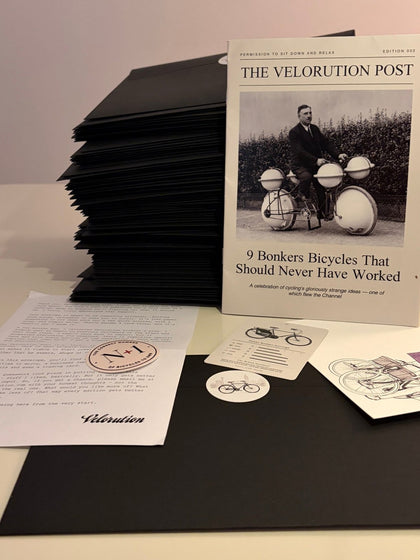
The Velorution Post
Real mail. Once a month.
We're all a bit digitally overwhelmed. So once a month I hand-pack an envelope and post it to you — a 16-page mini magazine, a letter, a collectable card. Things worth keeping, not junk through the door.

The Velorution Post
My pride and joy, through your letterbox
A 16-page mini magazine every month. No ads, just bicycle love. In the envelope with it:
- A letter from me
- A collectable trading card
- My real numbers, warts and all
Several readers have written to us describing their Velorution Strida with real affection. One has commuted on hers for years. Another has never needed to take his to a bike shop.
If you want to try one in 2026, start with the official Strida website and the Strida Forum. And if you own a Strida already, we want to hear from you.
Sources: road.cc · Dezeen · Wikipedia · Bikerumor · Strida.nl
Leave a comment (3)

Velorution Exclusive · October
Define Bicycle Mug
£18.00. One month only. Then it retires to the Velorution Vault and may never be seen again.
Get it before it's goneFrom the Collective


More stories


Charles · 1 May 2026
Fantastic boat bike too. Light, non-rusting, small and greaseless….I had mine stolen from a boatshed in Burnham-on-Crouch, which is probably a testament to that
Stuart Macalister · 1 May 2026
I still have a Strida 5 as a daily driver 1.5 miles to station , 30 mins on train and another 1 miles from Euston . Love it , such a smooth ride, great brakes and so well designed . Bought at Velorution in something like 2008/9 !
Not quite triggers broom but bought new mag wheels , brake calipers last year but most other non – disposal parts are original including the BB . Frame has been customised with some painting to hide scuffs and scratches . Would love to have some UK supply as the Dutch dealer is painful… and only accepted orders above 200 euros. In many ways it is so much better designed than a Brompton …which looks like an attachment for the back of a tractor ;-)
Jon Taylor · 1 May 2026
Love this Pete, this going gain a lot of momentum for you and Velorution
❤️