
Latest Stories
Vive la Vélorution: The Man Who Said It First

When we relaunched Velorution, one of our readers — who grew up in Montreal — sent us a message that gave us pause.
She pointed out — in a crushing blow to my creative ego — that the phrase "Vive la velorution" wasn't new. Long before Andrea Casalotti opened his first shop on Great Titchfield Street, the phrase had been used by cycling campaigners on the other side of the Atlantic. It was associated with a man called Robert Silverman — known to everyone as Bicycle Bob — and a scrappy, theatrical, utterly committed cycling advocacy group he co-founded in Montreal in 1975.
The group was called Le Monde à Bicyclette. And their story is remarkable.
Bicycle Bob
Robert Silverman was not, by any conventional measure, a man who did things quietly.
He had attempted to run a bookstore, but as an avowed Trotskyist discovered he wasn't adept at capitalism. He had lived in Cuba in the days after the revolution, picking sugar cane alongside Che Guevara. He had lived on a kibbutz. He had spent time in France, learned the language — and fallen in love with riding his bike.
When he returned to Montreal, he bought a second-hand bicycle to get around the city. At the time, that was not particularly common. But Silverman saw something others didn't: that the bicycle was not a toy or a sporting item. It was a solution. A simple, elegant, democratic solution to the problem of moving through a city.
In 1975, he co-founded Le Monde à Bicyclette — a group that would remain active until 1999 and is credited with inspiring Montreal's extensive bike path network.

The cyclo-dramas
What made Le Monde à Bicyclette different from a conventional lobbying group was how they made their case.
Silverman organised publicity stunts such as "die-ins" to draw attention to the many cyclists and pedestrians killed by drivers in Montreal. But they went further than that. They staged what our reader described as "cyclo-dramas" — theatrical, satirical, deliberately absurd performances designed to make cycling visible, political, and impossible to ignore.
On one occasion, Silverman dressed up as Moses and vowed to part the St. Lawrence River so cyclists could pedal between Longueuil and Montreal.
Silverman and his co-founder Claire Morissette split the city between them — each speaking to their respective linguistic community — in a two-pronged effort to convince Montrealers of all backgrounds that the bike had as much right to be part of the city's transit mix as the car.
Urban cycling news, honest stories, and a front-row seat as we rebuild Velorution from scratch. Free, every week.
Join 40,000+ following along
When Le Monde à Bicyclette was founded, nobody was talking about bike paths. By the time the group wound down in 1999, Montreal was becoming one of the most cycling-friendly cities in North America.
The phrase
Somewhere in all of this — in the protests, the die-ins, the theatrical stunts, the relentless campaigning — the phrase "Vive la vélorution" took hold in Montreal's francophone cycling culture.
It's a French verlan construction — a form of slang where syllables are inverted — applied to the idea of a cycling revolution. Whether Bicycle Bob coined it himself or it emerged organically from the movement around him, our reader couldn't say with certainty. What she was certain of was that it was part of the vocabulary of Montreal cycling culture long before it became the name of a London bike shop.
Andrea Casalotti arrived at the same phrase independently, on the other side of the Atlantic, driven by the same instinct: that cycling needed a revolution, and that revolution needed a name.
What happened to Bicycle Bob
Robert "Bicycle Bob" Silverman died in February 2022 at the age of 88. Montreal Mayor Valérie Plante said he was "a cycling pioneer in Montreal. An early activist, he helped make cycling safer and promote active mobility. We owe him a lot."
His mission had been twofold: to make cycling seem like a normal activity in an urban context, and to encourage cities to develop the infrastructure to support it.
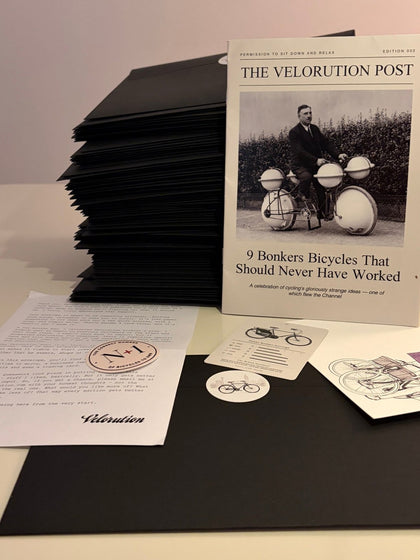
The Velorution Post
Real mail. Once a month.
We're all a bit digitally overwhelmed. So once a month I hand-pack an envelope and post it to you — a 16-page mini magazine, a letter, a collectable card. Things worth keeping, not junk through the door.

The Velorution Post
My pride and joy, through your letterbox
A 16-page mini magazine every month. No ads, just bicycle love. In the envelope with it:
- A letter from me
- A collectable trading card
- My real numbers, warts and all
Sound familiar? It's the same mission Andrea Casalotti started with in London in the late 1990s. The same one Mark Sanders had when he designed the Strida in 1982. The same one this newsletter is built around now.
The vélorution, it turns out, has been going on for a long time. It just keeps finding new people to carry it forward.
Vive la vélorution.
Leave a comment
No comments yet — be the first.

Velorution Exclusive · October
Define Bicycle Mug
£18.00. One month only. Then it retires to the Velorution Vault and may never be seen again.
Get it before it's goneFrom the Collective


More stories

