
Latest Stories
29 Rides That Show Any Bike Will Do

Last week I asked you to send me a photo of the bike you ride the most. Not your fanciest. The one with the wonky mudguard and the rack you never take off.
I'd just written a long piece about what the research on cycling and health actually found, and the thing I couldn't get past was this: across three decades and hundreds of thousands of people, not one of those studies recorded what bike anyone was riding. The effect was in the riding. Nobody weighed a frame.
So I asked. And you answered — far more of you than I expected, and for days afterwards.
They came in from Rome, Brooklyn, Amsterdam, Ontario, the South Downs, Haringey, Hammersmith. Bikes pulled out of skips and bikes built to order over eleven months. A bike bought for €50 and a bike with a Pinion gearbox and a 36-inch front wheel. Several people apologised for their bike. Nobody needed to.
Here they are. I've kept your words, because they're better than mine.
Rescued
Let's start with the one that made me laugh out loud, because it answers the question better than anything else I received.

Andrew:
An old dead man's muddy fox pulled from a skip many years ago and kitted with replacement parts from my shed as the originals wore out. Use it for shopping, pub, and moving about.
Shopping, pub, and moving about. That's the whole brief, really.

Toby's is the same idea, applied deliberately. His is a Raleigh town bike from the seventies or eighties, called Crusty, and it lives in Cambridge — which is the whole point:
Living in Cambridge, bike theft is obviously a concern. The key to staying safe here is to have a bike that looks as crappy as possible, whilst still being rideable.
Since the pic there's been a mudguard upgrade, and some Schwalbe Marathon tyres, but the fundamental idea is the same.
A lean, mean commuting machine in a deliberately terrible coat. There's no better anti-theft device than looking like nobody would bother.

Ian rides a Cannondale Bad Boy in Amsterdam, which he bought in the UK for £100 on eBay:
Brilliant day to day bike & with the hub gear takes all weather here outside in Amsterdam. Treated it to some Marathon tires & a pair of mudguards. Tucked in behind the electric bikes & am rarely dropped as I like to push on a little.
A hundred quid, a set of Marathons and some mudguards, holding a wheel in the fastest cycling city in the world. There's a lesson in there somewhere.

Giovanni wrote from Rome, where he rides 20 to 25km to work every day:
I bought this bike from a friend for 50 euros two years ago. At first I didn't like it and I thought about selling it, but once I started using it I realized how comfortable it is, especially in city traffic. Maybe it's a bit heavy, but I find it very solid.
I've basically forgotten my car in the parking lot.
Forgotten in the car park. Fifty euros. I'd frame that sentence if I could.

Robin bought his from a fellow Cycling UK member, who was selling it on behalf of a friend who'd had to give up riding. He's put more than 8,000 miles on it since — and, in the way of bikes that are genuinely used, most of it has been replaced at least once:
It has had a new rear wheel, a replacement hydraulic brake, a new bottom bracket, new pedals and a couple of replacement chains, rear cassette, and tyres — mostly done by me with the assistance of my local charity bike workshop.
I have other bikes (including a Puch Black Phantom that I bought in 1983), but this gets by far the most use.
The photo was taken while he was setting up a treasure hunt for his local district association, which explains, in his words, "the amount of gubbins on the bike".

Ross has had his Python ZX4 for a bit over eight years. It replaced a 1970s Raleigh that cracked at the head tube after a collision:
Turned eighty at the top of the year which has slowed me down and cut the mileage but I mostly use it for shopping trips, every day if that's possible.
Every day if that's possible. At eighty. Put that on a poster.
Given, not bought

Mark answered my four questions exactly as asked, and the answers are extraordinary:
what it is: a Surly Disc Trucker
why you got it: local bike folk gifted it to me
how long you've had it: since 2014 June
where it takes you: everywhere; I haven't owned a motor vehicle since 1991 and have about 45K miles / 72,420 km on it, mostly in town
Forty-five thousand miles. Mostly in town. On a bike somebody gave him.

Joe's story is the one that stopped me. His original bike was stolen from outside a shopping centre. The insurer decided he'd used the wrong kind of lock and, after some pestering, paid out £300 on a £1,500 bike. And then this happened:
My mate — who had sold me my original GB — offered to find me a replacement. Which he did (this). I had very little money so he bought it for me (aren't mates great?) and I paid him back £50 a month for as long as it took.
Aren't mates great. He rides it for commuting and group rides, including the local Gravelton series. It's currently in bits, because the back wheel blew up the other day and he had to hike-a-bike two or three miles home. Which is, I'd argue, still a better day out than most.
Kept for decades

DirtDance sent a 1998 Toyo-built Rivendell Atlantis, and it's the most thoroughly ridden bike anyone sent me:
My primary transportation for over 25 years. It has had three paint jobs, two 'frame saver' treatments and four complete component groups. Currently XX1 eleven speed, with a wacky, but very ergonomic shifter adapter for drop bars I came up with. I made/make all my own bags.
I own five bikes, zero cars.
Car-free for around fifteen years, and recently — reluctantly — added a Tern electric cargo bike for groceries and trips to the laundromat. Five bikes, zero cars. Twenty-five years on the same frame.

Ben's Fahrrad Manufaktur is thirty years old and was chosen partly for how unremarkable it looks:
Bought because of the quality of the then bike co-operative manufacture, now bought out, and of modest appearance so as not to attract the thieves who had stolen its more obviously attractive other make predecessor. It has 7 hub gears, and is a sturdy servant which goes on giving much pleasure in my seventh decade.
A sturdy servant. I'm stealing that.


David sent two, because he has a dry-weather bike and a wet-weather bike, which is the correct number of bikes. The wet one is a Pedersen:
The Pedersen I first saw in Copenhagen in about 1981, loved it and vowed that I would get one "when I grew up" — it took about 25 years (!!) and I have now had it for almost 18 years. It was repainted by the awesome Cole Coatings in the colours of the London underground lines.
The dry one was built for him by Dear Susan five years ago: a 36-inch front wheel, a 24-inch rear, belt drive and a Pinion gearbox, loosely based on the 1870s Lawson Bicyclette.
I didn't want a replica, more a bike fit for day-to-day use in the 21st century.
Twenty-five years of wanting one, eighteen years of having it. That's how this works.


Steve is 71, and down to one bike:
At the age of 71 my others were no longer practical but this one enables me to ride regularly at a relaxing pace and enjoy every mile peering over hedge rows and stopping to admire the views. It is of course a Dawes Galaxy Classic but one made in 2016 just 4 years before all Galaxy production ceased.
I used to teach and these panniers carried all my marking books home over the South Downs every working day of the week.
⚡The Weekly Journal · By Email⚡
Urban cycling news, honest stories, and a front-row seat as we rebuild Velorution from scratch. Free, every week.
Join 40,000+ following along
Those panniers have carried a career's worth of marking over the South Downs. He also added something I've been thinking about since: that too many older riders are giving up because the roads feel too dangerous to venture out on. That's not a bike problem. That's a road problem, and it's ours to fix.


Mari's Kona Dew Drop was bought for a very big trip and kept for the small ones:
why you got it: A long distance cycling trip — cycled across the US and then New Zealand's north island to Christchurch then some of Australia's east coast in 2012
where it takes you: 25 minutes to my work in Haringey, 10 mins to my swim club. I go very fast down hill as it's so heavy especially with my big bags!
A bike that crossed America now does the run to the swimming pool. Nothing sad about that at all — that's a bike being properly used.
Chosen carefully, ridden constantly

Mick's Mercian 853 Pro Lugless took eleven months to arrive, and he's clear about why he ordered it. In 2015 he had three race bikes — a Colnago CT2, a 1991 Colnago Master Olympic and a Litespeed Vortex — and no bike that could simply do things:
I sold the Master Olympic and Litespeed and it was an obvious choice to go Mercian, designed around the superb handling Colnago CT2 but with mudguard clearance.
It is my weekly commuting bike, took me to the D-Day 80th Anniversary in France and here, with full fly fishing gear, on the way to Ladybower Reservoir. Perfect for a local shop and a weekly trip to 5 a side football.
He sold two beautiful race bikes to buy one bike with mudguard clearance. Reader, he was right.

Michael's is about as pared-back as it gets:
My pride and joy. Nearly two years old. Custom built, Reynolds 853. Fixed gear. Ride every day about 12 miles.

Nick confessed to owning six bikes, which he says all have different jobs. This one is a Shand Stoater called Bluey:
This week we have been on several gravel rides in my local Kings Forest, a shopping trip & a night gravel ride. The picture was taken on a lunch ride… involves taking my camp stove, cooking lunch & relaxing in my hammock, taking in the sights & sounds of nature.
Riding to a forest to cook lunch and lie in a hammock is, I think we can agree, the correct use of a bicycle.

Paul's Moulton is called Tango, and he bought it on eBay as a bad-weather bike. It has since become the opposite of that:
It demonstrates 'marginal losses' — the hub gear, Brooks saddle, rack and bag, and Marathon Plus tyres all affecting 'performance'. But it's the bike I ride most often and the one I chose to do LEJoG on last year.
Marginal losses. He rode Land's End to John o' Groats on the heavy one, on purpose. That's the best joke anyone made all week.


Dario grew up in Camden Town and now rides a WorkCycles GR8 around Hackney — a Dutch-built workhorse, and emphatically not an electric one:
This is my dutch GR8 made by Workcycles (Amsterdam). I use it for everything basically. Its an incredible machine (non electric).
I use it for everything basically. That's the entire case for a proper Dutch bike in one sentence.
The ones that changed something

Chet, in North London:
I've had my Brompton for over 15 years. About 5 years ago I converted it to electric and that's helped me continue cycling despite health issues.
Two sentences. That's a bike doing more work than most bikes ever get asked to do.

Will bought his Brompton four months ago on the cycle-to-work scheme, and rides Chiswick to Mayfair and back:
It really made me fall in love with cycling again after a few years away from it. It gives great freedom and flexibility for travel in a big city, and honestly is way nicer and more fun to ride than I thought it would be.
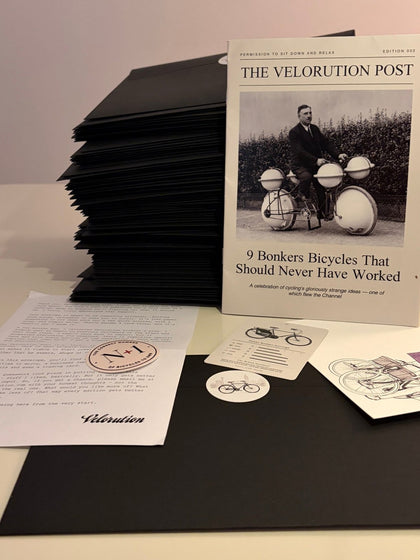
The Velorution Post
Real mail. Once a month.
We're all a bit digitally overwhelmed. So once a month I hand-pack an envelope and post it to you — a 16-page mini magazine, a letter, a collectable card. Things worth keeping, not junk through the door.
Subscribe to the Post£12.00/month · cancel any timeThe Velorution Post
My pride and joy, through your letterbox
A 16-page mini magazine every month. No ads, just bicycle love. In the envelope with it:
- A letter from me
- A collectable trading card
- My real numbers, warts and all
See what's inside£12.00/month · cancel any time


Mat has been cycling in London for 27 years, and currently does Hammersmith to Stratford and back every day:
I have this bloody wonderful Reise and Muller Supercharger to get me from Hammersmith to Stratford and back every day. I have a Koga World Traveller analogue bike for touring.
"Analogue bike" is now the only phrase I will use for a non-electric bicycle.

Ian used to commute into London by bike and gave up on it — not on the bike, on the city:
Got fed up of the daily commute into London (on the bike) as motorists are just generally too disrespectful to cyclists. Ditched the office, work from home, but still 'commute' every day 25 miles into the Surrey countryside. This is gravel Mk2. Mk1 I cracked the frame after 22,000 miles.
He kept the ride and threw away the office. Twenty-two thousand miles into the first frame.

Patricio wrote from Ontario about his 2021 Orbea Orca — "5 years partner in life" — which he rides in the annual Great Cycle Challenge, raising money for childhood cancer research through the SickKids Foundation.
And a few more

Everett's Electra Townie 3i is a working vehicle:
It hauls a pet trailer, cargo trailer, has a Topeak trunk bag with rain gear and locks. It climbs relatively well and cruises at an average speed of 11 mph. It's about getting there happily.
It's about getting there happily. Honestly, that could be the tagline for this whole thing.

Mark sent his city commute in Brooklyn.

And one reader sent a photo with no name attached and one perfect line:
This is my favorite bike. I take her everywhere. On any road, no matter how broken, pot-holed or smooth, city or country.


Sully sent photos and a thank you, which is plenty.
Two more arrived without pictures but deserve a mention anyway. One reader simply said: "My bike is a Trek Marlin 5 MTB." And another, who I hope rides for another thirty years:
I'm 70 I've had an e-bike for three years love it no problems yet well only stupid riders happy days
What I noticed
A few things, now they're all in one place.
Hardly anybody led with the bike. They led with where it takes them, or who gave it to them, or how long they've had it. The specs came second, if at all, and usually only to explain why the bike suits the job.
Almost everything here has been repaired rather than replaced. New wheels, new bottom brackets, four component groups, three paint jobs, parts from a shed, help from a charity workshop. These are not consumer goods. They're more like a pair of boots you keep getting resoled.
The age range genuinely surprised me. Ross is eighty and shops by bike every day he can. Steve is 71 and down to one. Ben is in his seventh decade on a thirty-year-old frame. This is not a young person's activity and it never was.
And the price range spanned two orders of magnitude — a skip, £100 on eBay, €50 from a friend, all the way up to a custom Mercian and a Pinion-geared one-off — without any of it changing the substance of what people wrote. Everyone described the same thing: freedom, usefulness, and a bit of joy on the way to the shops.
Which is what the research said too, in its own bloodless way. Nobody weighed a frame.
Thank you to everyone who sent one in. I read every single one, and I'm sorry it took me a few days to reply to some of you. If yours isn't here, send it again and I'll add it — I genuinely want this page to keep growing.
And if you've read this far and you're looking at a bike in your shed with a slow puncture: that one's fine. That one will do.
Leave a comment
No comments yet — be the first.

Velorution Exclusive · October
Define Bicycle Mug
£18.00. One month only. Then it retires to the Velorution Vault and may never be seen again.
Get it before it's goneFrom the Collective


More stories

