
Latest Stories
Bickerton: The Folding Bike That Accidentally Invented Its Own Rival

Every folding bike story I've heard starts with a bike. This one starts with a drink-driving ban.
The engineer who couldn't drive
Harry Bickerton was born in 1921 and left school at seventeen for an apprenticeship at Rolls-Royce in Derby. He was good enough that he was seconded to the Royal Aircraft Establishment at Farnborough to work on the Merlin engine - the thing powering Spitfires through the Battle of Britain. After the war he moved to de Havilland, spending decades as an aircraft engineer before turning, almost by accident, to bicycles.
In 1970, Bickerton was in a car crash and convicted of drink-driving. He got a three-year ban. A man in his late forties with a career built around aeroplanes suddenly had no way to get around - so, being an engineer, he designed his way out of the problem. He wanted something light enough to carry onto a train, small enough to live in the boot of a Mini, and durable enough that his aerospace background wouldn't feel wasted on it.
He patented the design in 1971 and put it into production the following year from a small operation in Codicote, Hertfordshire.

A bicycle engineered like an aeroplane
The Bickerton Portable was unlike anything on the road. It was built entirely from aluminium extrusions with no welds anywhere on the frame - the whole thing held together by interlocking hinges and clamps, aircraft-style. The prototype weighed 8.8kg; the production version, strengthened after early testing, settled at 9.1kg. Folded, it packed down to 76cm x 51cm x 23cm, small enough to genuinely disappear under a desk or into a cupboard. It ran on a single 14-inch front wheel with a pressed aluminium fork, and depending on the year, you could have it in three-speed, five-speed Sturmey-Archer hub, or briefly, a six-speed derailleur version.
It was also, by most accounts, a demanding thing to ride well. The long, sweeping handlebars were prone to flexing under load. Getting it rideable meant carefully tightening five separate clamps, the main handlebar clamp especially - loose, and the whole front end would twist. The small front wheel and pressed fork didn't self-centre the way a normal bike's does, so it wandered at low speed. Overload the handlebar-mounted bag and the steering got worse. And the very long seat post, needed to fit taller riders, was known to develop stress fractures over time. Clever engineering, demanding ownership.

Original Bickerton design - IMAGE CREDIT: BICKERTON
None of that stopped it selling. Production ramped from around 300 units in its first two years to roughly 1,000 a year once the TCK Group in Aston took over manufacturing during the 1973 oil crisis - when a folding bike that lived in the boot of your car suddenly looked like a very sensible thing to own. The 1975 recession did what the oil crisis couldn't: the original company went bankrupt in 1977. Production carried on regardless - an Australian licensee built an estimated 50,000 units between 1977 and 1982, before UK manufacturing resumed at Welwyn Garden City from 1982 to 1989, adding a larger-wheeled "Country" model in 1988 along the way. The factory finally closed for good in 1991. Estimates of the total run vary by source, but the widely repeated figure is somewhere around 600,000 Bickertons sold worldwide over that whole period, across three countries and at least three separate manufacturers.
The party that started Brompton
Andrew Ritchie graduated from Cambridge with an engineering degree in 1968 and, by his own account, had no background in bicycle design whatsoever. Sometime around 1975 or 1976 - accounts differ on the exact year - he came across a Bickerton, reportedly at a friend's flat, and had two reactions at once: this is a genuinely brilliant idea, and this particular execution of it isn't very good.
He went home and started sketching anyway. Working from the bedroom of his own flat, which happened to overlook the Brompton Oratory in South Kensington, he built his first prototype in 1975 and named the bike after the view out of his window.

Urban cycling news, honest stories, and a front-row seat as we rebuild Velorution from scratch. Free, every week.
Join 40,000+ following along
Andrew Ritchie developing the first Brompton - IMAGE CREDIT: BROMPTON
Ten years of being told no
In 1976, Ritchie took the design to established bicycle manufacturers, Raleigh among them. They all turned him down. What followed was closer to a decade of hand-building bikes to order from a small rented workshop than anything resembling a normal product launch.
Ten friends put in £100 each to fund the first batch of prototypes. Thirty more pre-ordered bikes against £250 deposits before a single production model existed. In the early 1980s he raised £8,000 from a small group of shareholders and turned out around 500 bikes over two years, built from his bedroom. Banks and bike companies kept saying no.

The first Brompton - IMAGE CREDIT: BROMPTON
"Every time there was a setback I wanted to call it quits," Ritchie has said of this period. "But I was unable to due to the unstinting support of friends, family, and investors."
The turning point came from an unlikely direction. In 1982, Julian Vereker - founder of Naim Audio and a yacht builder - bought two Bromptons after a conversation about folding bikes while moored in Cherbourg. He stayed a fan for years, and in 1987 finally stepped in properly: guaranteeing a £40,000 overdraft and helping raise more than £50,000 in additional equity. That was the money that let Ritchie move out of his bedroom and actually manufacture at scale. The same year, the Brompton won Best Product at the Cyclex Exhibition. Twelve years after that first sketch, it had a real factory and a real launch.
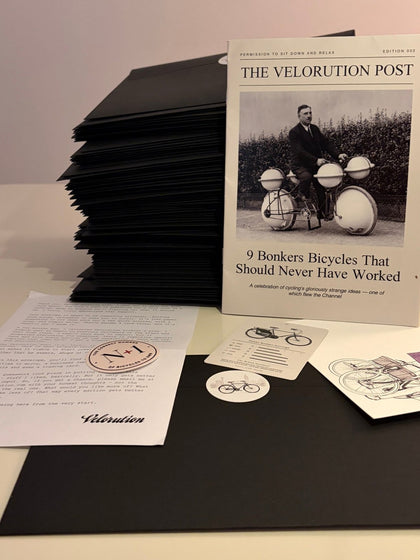
The Velorution Post
Real mail. Once a month.
We're all a bit digitally overwhelmed. So once a month I hand-pack an envelope and post it to you — a 16-page mini magazine, a letter, a collectable card. Things worth keeping, not junk through the door.

The Velorution Post
My pride and joy, through your letterbox
A 16-page mini magazine every month. No ads, just bicycle love. In the envelope with it:
- A letter from me
- A collectable trading card
- My real numbers, warts and all
Same idea, completely different bike
Ritchie has credited the Bickerton directly as one of his inspirations for the Brompton - but what he built shares almost nothing with it mechanically. Where the Bickerton is aluminium, clamped together, and built around a small 14-inch wheel, the Brompton is steel, hinged rather than clamped, and runs a larger 16-inch wheel that rides far more like a normal bicycle. The fold itself is completely different: the Bickerton comes apart at five separate clamp points, while the Brompton tucks in on itself in three connected movements - rear triangle swinging underneath, front wheel folding in, seatpost dropping down - without a single tool or a single piece separating from another.
What Ritchie actually took from the Bickerton wasn't a mechanism. It was a conviction: that a bicycle could genuinely disappear into a small enough package to live indoors with you, not just in theory but in daily use. He then spent a decade proving the Bickerton hadn't gone nearly far enough.
Where they ended up
Bickerton the company didn't survive its own idea. After the 1991 factory closure, the brand sat dormant for two decades. It came back in 2011, relaunched at the Munich Bike Show by Mark Bickerton, Harry's son and, fittingly, president of the Bicycle Association of Great Britain. The brand returned to its home market in December 2013, distributed in the UK by 2x2 Worldwide from March 2014. Modern Bickertons are now manufactured by Tern, in Taiwan and Vietnam - built by a company whose own designers, in a nice loop, grew up on folding bikes shaped by everything Ritchie learned from Harry Bickerton's original mistakes.
Brompton, meanwhile, never stopped. It's now one of the most recognisable folding bikes in the world, still made in Britain, still hand-built to the same basic three-fold principle Ritchie worked out in his South Kensington bedroom in 1975.
Neither bike exists without the other. That's the part of this story I keep coming back to: not the bike that won, but the one that made the winner possible by being clever, flawed, and just good enough to annoy exactly the right person at exactly the right party.
See Bickerton Portables → See Brompton →
Sources
Leave a comment
No comments yet — be the first.

Velorution Exclusive · October
Define Bicycle Mug
£18.00. One month only. Then it retires to the Velorution Vault and may never be seen again.
Get it before it's goneFrom the Collective


More stories

