
Latest Stories
The 13.3kg Folding E-Bike Built in Cambridge — Lighter Than a Brompton, Half the Price

This article is sponsored by FLIT. They paid for the slot; the words are mine. FLIT also gave us this story a week ahead of the rest of the press.
There is a moment that decides whether you actually use a folding e-bike, and it isn't on the road.
It's the stairs at Angel. It's the gap between the platform and a 07:52 that's already full. It's the gangway onto a boat, or the four flights up to a flat with no lift. That's the moment a folding e-bike either earns its keep or turns into luggage you happen to have paid three grand for.
Most of them turn into luggage. The average folding e-bike weighs about 20 kilos. You can ride 20 kilos perfectly happily. You cannot carry it up a staircase twice a day without it changing how you feel about the whole idea.
Which is the problem FLIT have spent the last few years chewing on, from a workshop in Cambridge. This week they've launched their answer.

IMAGE CREDIT: FLIT
The number
The FLIT M2i weighs 13.3kg, battery included, and costs £2,999.
To put that where it belongs: in the class of folding e-bikes that fold properly and come fully equipped — the premium, compact end of the market — the benchmark is the Brompton Electric T Line, which Brompton's own spec sheet lists at 13.8kg with its battery, for £5,799. There are lighter folding e-bikes out there, but they get there by stripping things away: no lights, a token fold, or an all-in-one hub motor that dictates the whole bike. In the category most of us actually mean when we say folding e-bike, it's FLIT and Brompton, then daylight.
So the M2i is half a kilo lighter than the lightest Brompton, at a little over half the price. It's also 1.2kg lighter than FLIT's own standard M2, which was already a light bike at 14.5kg.
I've watched this particular arms race for a while and the interesting part isn't the half kilo. It's how it was found.
No titanium
The conventional way to make a folding bike light is to make it out of something expensive. Titanium is the usual answer, and it's most of why a T Line costs what it does.
FLIT haven't done that. The M2i's frame is anodised 6061 aluminium — an entirely ordinary material — and the weight comes out of how it's put together instead.
FLIT don't weld their frames. They bond them, with structural adhesives, in Cambridge. It's the technique that holds together the chassis of a Lotus Elise and an Aston Martin DB9, and FLIT have been developing it with support from Innovate UK, the Royal Academy of Engineering and the Advanced Propulsion Centre.
The reason is heat. Welding aluminium distorts it. FLIT learned that the hard way on their first bike, the FLIT-16: the tubing moved during welding and heat treatment, so every joint had to be built with slack in it to absorb the variation — and all that slack ended up in the folded size. Bonding happens at low temperature, nothing warps, and the tolerances come right in. As their MD Alex Murray put it to road.cc's ebiketips, every bike now comes off the line practically identical.
That matters more on a folder than on any other kind of bicycle. A folding bike is a machine made of hinges, catches and things that have to line up. Slop in the frame is slop in the fold.
The other benefit is where the electronics live. The M2i was designed to be both folding and electric from scratch, rather than as an electrified version of an existing folder — which is why it has no visible battery pack and no cables looped round the head tube. The Brompton, by contrast, carries its battery in a clip-on pack on the luggage block above the front wheel — a genuinely clever piece of design in its own right, but a separate object you have to remember.
"If manufacturing is going global, the UK wins by doing the hard stuff well: innovation, design, and advanced manufacturing. We're bringing that approach to the bike industry." — Alex Murray, Managing Director, FLIT
I'd normally skip past a quote like that. I'm leaving it in because there are not many people making bicycle frames in Britain at all, let alone making them with a process borrowed from the car industry, and the M2i is the argument for it.

IMAGE CREDIT: FLIT
Where the rest of the weight went
A frame process gets you part of the way. The other 1.2kg between the M2 and the M2i is bought, part by part — FLIT reckon about £875 worth of upgrades over the standard bike.
- Hope XCR Pro X2 hydraulic disc brakes, front and rear — machined in Barnoldswick, Lancashire. Proper brakes on a 16-inch-wheeled bike is not a given, and Hope on a folder is close to overkill in the best way.
- Goodyear Eagle F1 R tyres, 30-349. Fast, supple, and a road tyre rather than a city tyre — more on that below.
- fizik Vento Antares R3 saddle, Italian, out of the road-racing catalogue.
- TPU inner tubes and a hollow-pin KMC chain — the sort of grams you only chase when you've already found the big ones.
- An ultralight finishing kit: AMS Extralight grips, Union Jack POM pedals.
None of that is exotic. All of it is the kind of thing a rider with a workshop and a credit card would fit themselves, which is a slightly unusual way to build a production bike and, I think, an honest one. FLIT haven't invented a mystery material. They've made a good frame and then hung the light stuff on it.
What it hasn't given up
This is the part I care about most, because getting light is easy if you're allowed to delete things.
The M2i still folds down to fit a train luggage rack — 797 × 600 × 305mm. It still rolls along on its own wheels when folded, which sounds trivial until you've dragged a bike that doesn't through a station concourse. It still has front and rear lights built in, the front an integrated 90-lumen LED in the handlebars, the rear built into the battery. It runs a torque sensor on both sides of the bottom bracket, so the assistance responds to how hard you're actually pedalling rather than simply switching on.
"We didn't want to build a 13kg bike that only looks good on a set of scales. A folding ebike earns its keep when you have to carry it up station stairs or squeeze it onto a busy commuter train." — Alex Murray
⚡The Weekly Journal · By Email⚡
Urban cycling news, honest stories, and a front-row seat as we rebuild Velorution from scratch. Free, every week.
Join 40,000+ following along
That's the right test, and it's the one I'd apply to it.

IMAGE CREDIT: FLIT
Where it loses to a Brompton
Since this is a sponsored article, here's the section that makes the rest of it worth reading.
The battery is small. 230Wh, for a claimed 50km. Worth being fair about how the two numbers were made, though: FLIT's 50km is a real-world test — a 90kg rider, mixed terrain, assist level 3 of 5, and Alex Murray runs the tests himself. Brompton's "up to 90km" is exactly that: up to, on the lowest assistance, on the flat. Lithium-ion cells are lithium-ion cells, so like-for-like the 345Wh Brompton should go roughly 50% further, not nearly double. Still — that is the trade. You are buying the lightness with range, and if your commute is 20 miles each way, this is not your bike.
It folds smaller than most, but not smaller than a Brompton. The M2i is 797mm long folded; the T Line is 645mm — though note Brompton's folded dimensions are measured with the battery taken off, while FLIT's include everything. Even so, it's a real gap, and Brompton's fold remains the best in the business. No one has caught it.
It's a single speed. 48 × 12, a 5:1 gain ratio, with a 250W rear hub motor putting out 35Nm. That's a good deal more torque than the T Line's 24Nm, and the climbing evidence is better than you'd guess: at the 2024 Urban Hill Climb up Swain's Lane, riders on standard M2s took second and third in the e-bike category — FLIT sponsored the event, so add salt to taste, but the results sheet is public, and they've ridden a FLIT up Snowdon for good measure. The honest caveat is what happens on a steep, long hill with a flat battery: one gear and your legs. Fine in Cambridge. Test-ride first if you live in Sheffield.
The rider weight limit is 100kg, including luggage. That's low, and it's the sort of thing you find out after you've ordered. If you're a 95kg rider with a laptop bag, you're at the limit.
Mudguards and a kickstand are extra — and they're extra weight too, +450g and +180g respectively. A genuinely all-weather M2i is closer to 13.9kg, which is still remarkable, but it isn't the headline number.
Those tyres are fast, not tough. Goodyear Eagle F1 Rs are a lovely thing to ride on and a road tyre in a 16-inch size on a British winter road surface is going to be a more eventful experience than a Marathon. TPU tubes are light and not famously easy to patch at the roadside.
And there are ten of them. FLIT are delivering an initial batch of ten M2is by the end of August 2026, with further limited batches as capacity allows. That is not a supply problem so much as a description of what a small British manufacturer actually is — but if you want one this autumn, ten is the number to have in your head.
M2i vs Brompton Electric T Line
| FLIT M2i | Brompton Electric T Line (1-speed) | |
|---|---|---|
| Price | £2,999 | £5,799 |
| Weight, with battery | 13.3kg | 13.8kg |
| Frame | Bonded 6061 aluminium, Cambridge | Titanium and carbon |
| Motor torque | 35Nm | 24Nm |
| Battery | 230Wh, in-frame | 345Wh, luggage-block pack |
| Claimed range | 50km | 90km |
| Folded length | 797mm (battery in) | 645mm (battery off) |
Read that table honestly and it says something quite specific: the M2i is the better buy on price, weight and pull, and the Brompton is the better buy on range and fold. Which of those two lists matters more is a question about your life, not about the bikes.
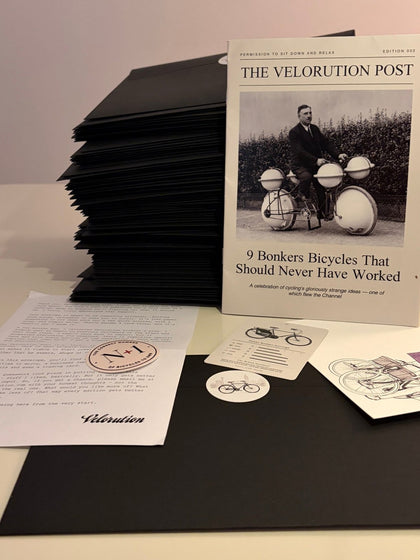
The Velorution Post
Real mail. Once a month.
We're all a bit digitally overwhelmed. So once a month I hand-pack an envelope and post it to you — a 16-page mini magazine, a letter, a collectable card. Things worth keeping, not junk through the door.

The Velorution Post
My pride and joy, through your letterbox
A 16-page mini magazine every month. No ads, just bicycle love. In the envelope with it:
- A letter from me
- A collectable trading card
- My real numbers, warts and all
Who this is actually for
The M2i is for the multi-modal commute. Ride to the station, carry it up the steps, stand it in the luggage rack, ride the other end. Every kilo you take out of that is felt twice a day, five days a week, and it's the only use case where 500g is worth arguing about.
It's also, quietly, for people who travel — the weight and the fold are pitched at getting a bike onto a boat, and 13.3kg is under the limit of what one person can carry up a gangway without regretting it. (Not a plane, mind — airlines won't carry an e-bike battery this size, so unless you fly private, the adventure extension is nautical.)

Unless, of course, you fly private. IMAGE CREDIT: FLIT
It's not for long-range riding, and it's not for anyone who wants to leave a bike out in the rain for four years and think about it as little as possible. That's a Brompton with a Marathon on it, and there's no shame in that.
There's a cycle-to-work route, and FLIT will take a trade-in against an existing FLIT — worth knowing if you already have an M2 and the 1.2kg is nagging at you. And if you want to try before you decide, FLIT run test rides around the country — three sites in London, with Bristol coming soon. They stock the standard M2 rather than the M2i, but the fold, the fit and the ride are the same story; only the weight differs. And if you'd rather just ask a human, FLIT are happy to be contacted directly — they're the sort of company that actually picks up the phone.
The bit where I admit I haven't ridden it
I haven't. Nobody outside FLIT has — this launched this week, and we're publishing early.
So I can tell you what it weighs, what's on it and how it's made, all of which is documented and checkable. I can't tell you how the single speed feels on a 12% climb, how the Goodyears behave on a wet Cambridge roundabout, whether 50km is optimistic, or how a bonded aluminium frame feels after three winters of being thrown into a luggage rack. Those are the questions that matter and they take months to answer.
What I'll say is this. The bike industry has spent twenty years making folding e-bikes heavier and calling it progress — bigger batteries, bigger motors, more of everything, and a machine you don't want to pick up. A small team in Cambridge has gone the other way, using a manufacturing process nobody else in bikes is bothering with, and come out 500g under the most expensive folder on the market at half the money.
Whether it's the right bike for you depends on that table. Whether it's a genuinely interesting thing to have built in Britain in 2026 doesn't really depend on anything.
I'll ask them for one. When I've had it a few months in the wet, I'll tell you what it's actually like.
FLIT sponsored this article and gave us the M2i story a week before the rest of the press. Neither arrangement changed a word of what I've written. Specifications are FLIT's own; Brompton figures are from Brompton's published specification.
Leave a comment (1)

Velorution Exclusive · October
Define Bicycle Mug
£18.00. One month only. Then it retires to the Velorution Vault and may never be seen again.
Get it before it's goneFrom the Collective


More stories


Dizzy · 17 August 2026
Just bought an M2 a couple of months ago from the lovely people at Bikesoup. Loving it so far. Luggage needs a bit of thinking about but the Carradice bag on the back works for me for now. Slightly annoyed that this is coming out as would have loved to go a bit lighter!