
Latest Stories
How Drum and Bass Showed Birmingham Its Cycling Potential

On a Sunday afternoon in September, a DJ on a cargo bike filled Victoria Square with bicycles. There were school kids, grandparents and families towing toddlers in trailers, and by the local papers' count there were thousands of riders in all. And when reporters asked them about cycling in Birmingham, the same thing kept coming up: it felt safe because there were so many of them, and they wished it could feel like that every day.
Velorution was a London bike shop for years, and London has been arguing about blue cycle lanes for most of them. Birmingham is now having its own version of that argument, and I think it's a more interesting one than you might expect. It mostly comes down to two roads: the A38 Bristol Road and the A45 Coventry Road.
A Sunday in Victoria Square
The ride set off on Sunday 13 September. It wasn't a sportive and nobody was wearing a number, because this was Dom Whiting's Drum & Bass on the Bike, the travelling rave he started during lockdown. He rides at the front with his decks and a sound system mounted on a cargo bike, and everyone else follows. This time the route ran out of Victoria Square, through the city centre and under the railway arches of Digbeth, and finished at the Hippodrome.
Dom Whiting's own video of the Birmingham ride. VIDEO: Dom Whiting
One grandmother, Sian Hooson, told the Birmingham Mail she doesn't ride in the city at all. "I would love to cycle in Brum but only if it's on cycle lanes," she said. "So I don't cycle here."
Adam had come over from Stourbridge with his nine-year-old daughter, and he said much the same thing from the other side: "Riding in such a large group made us feel protected and safe – the way cycling should always feel. If only it could be like this all the time."
And Dean, from Smith's Wood, who has been on eight or nine of Whiting's rides, said what makes them special is "the fact everyone turns up – everyone, every age, it doesn't matter." That's exactly the crowd every transport plan in Britain says it wants on a bike.
I think events like this matter more than they look, because for a couple of hours they give people a real taste of what life in a city built around bikes could be like. I had the same realisation the first time I visited Amsterdam and Copenhagen. It broke the idea that cars inevitably have to dominate a city, and it showed me that places with far less traffic are more beautiful, more peaceful and much more enjoyable to be in. On 13 September, thousands of people in Birmingham got a small dose of that.
After the ride, Whiting teamed up with the campaign group Better Streets for Birmingham to write an open letter to Councillor Rob Grant, the Green councillor who is now the city's cabinet member for transport. The ride, they wrote, "demonstrates the clear demand for a city-wide network of safe cycle routes", and it only worked "because of safety in numbers". They pointed out that Birmingham has "only 20km of separated cycle lanes", asked for routes that already have funding to be built "at pace", singled out the second phase of the A45 Coventry Road route, and signed off with a nod to Field of Dreams: "If you build it, they will come."
Grant replied that the A38 and A45 schemes both remain key priorities, with construction on both expected to begin next year, subject to the necessary approvals. So those are the two roads worth looking at.
Birmingham's blue routes: a short history
If you ride in London, you'll recognise the colour. In 2019 Birmingham opened two segregated cycle routes into the city centre, both surfaced in bright blue:
- The A34, running 4.5km north to Heathfield Road in Birchfield, which opened in April
- The A38, running 4km along the Bristol Road out to Selly Oak, which opened in June
When the A38 opened, the council made a point of saying it used "road space that has been reallocated from motor vehicles", which wasn't something many English councils were boasting about in 2019.

The A38 blue route in Edgbaston, a few months after it opened in 2019. IMAGE CREDIT: David Smith, CC BY-SA 2.0, via Wikimedia Commons
The blue routes were the showpiece of the Birmingham Cycle Revolution, which also put an all-weather surface on more than 50km of canal towpath and gave away 7,000 free bikes in the city's most deprived areas. And the ambition was big: 5% of all trips in the city by bike by 2023, and 10% by 2033.
Then came 2020. With traffic down 60% in lockdown, the council put together £1.6m of emergency money for pop-up lanes on seven routes, wider pavements in Stirchley and Moseley, and its first low-traffic neighbourhoods. Some of it stuck, too. The pop-up lane on the A45 Coventry Road, for one, was made permanent in 2024, and I'll come back to that road below.
The Birmingham Transport Plan followed in October 2021, promising that walking and cycling "will become the first choice for most people making short journeys in their local neighbourhoods". Since then work has started on a segregated link from the A38 towards Cannon Hill Park and Moseley, and a protected route has gone in along Dudley Road, with its final phase, past the old City Hospital, under way since January.
That's real progress, but it's still a handful of lines on a map rather than a network. And two of those lines are about to get longer.
The A38 Bristol Road: finishing the job to Longbridge
Today's blue route on the A38 stops at Selly Oak. The council wants to take it about 6km further south to Longbridge, which would give one continuous corridor from the edge of the city into the centre.

Bristol Road at Selly Oak in 2024. The extension would carry the blue route on towards Longbridge. IMAGE CREDIT: Andrew Abbott, CC BY-SA 2.0, via Wikimedia Commons
The clever bit is where it goes. Most of the new track would run down the central reservation of Bristol Road South, the wide grassy strip between the two carriageways, much as the existing route already does through parts of Edgbaston. Because the space comes from the middle of the road, most of the scheme doesn't need to take a traffic lane from anyone.
The council's outline business case weighed up the alternatives, and they're worth a look:
- Do nothing: still £0.6m, because the design work has already been paid for
- Resurface only: £5m
- Two-way track along the western footway: £21m, rejected because of the impact on homes and businesses
- One-way tracks on both sides: £28.9m, the most expensive
- Central reservation (preferred): £22.5m
Of that £22.5m, £14.5m is a Department for Transport grant managed by Transport for West Midlands, and the other £8m comes from local pots: £4m of Clean Air Zone surplus and £4m from bus-lane fines. Local councillor George Hall points out that this money can only be spent on transport, so it can't go on other services or road repairs, though he adds that this "does not mean the cost of the scheme should be beyond scrutiny". I think that's fair.
The 2025 consultation drew 850 responses, with 56% in favour, 39% against and 5% neutral. Councillor Rebecca Waters, whose ward sits just beyond where the route would end, put the other side bluntly: "Nearly 4 in 10 people who took time to respond said no."
The timetable has slipped, as these things do. Cabinet approved the outline business case in November 2025, and in February it approved a plan to appoint a contractor, with work pencilled in to start in October this year. That has since moved back. The full business case still has to be signed off, a consultation on the Traffic Regulation Orders is due later this year, and construction is now provisionally scheduled for 2027.
The bigger worry is money. In February a regional review of more than 150 transport projects, the Rosewell Review, proposed around £5m for the A38 extension instead of the £14.5m the council had planned on. The council's managing director, Joanne Roney, told councillors it was "a recommendation which hasn't been agreed yet", and that if the funding changed, the council would have to come back to it. I haven't been able to find a final decision since, so until there is one, the extension is a good plan without guaranteed funding.
But the case for finishing it is strong. Between February 2023 and January 2024, the existing blue route on Bristol Road and Sir Harrys Road averaged 501 riders a day, the highest of any counter in the West Midlands, according to the independent West Midlands Cyclotron. One of those riders is James, who rides it to school every day. "When I pass under the cycle counter sign on the A38 route," he told the Walking and Cycling Index, "it really makes me happy to know that there are lots of other people cycling to and from work and school instead of taking the car."
Urban cycling news, honest stories, and a front-row seat as we rebuild Velorution from scratch. Free, every week.
Join 40,000+ following along
The A45 Coventry Road: a bike lane for people without cars
The A45 is a less glamorous road than the Bristol Road, and in some ways the scheme on it matters more.

Coventry Road, Small Heath, in 2015, five years before the first pop-up lane. IMAGE CREDIT: Chris Whippet, CC BY-SA 2.0, via Wikimedia Commons
Phase one started as one of 2020's pop-up lanes, running from Bordesley Circus to Oldknow Road, and was made permanent in October 2024. Phase two takes it on another 2.7km, from Oldknow Road to Swan Island, with:
- a two-way segregated track as far as Holder Road, then one-way tracks on each side
- new and upgraded crossings, with separate crossings for people walking and cycling
- a "cyclops" junction at Forest Road, with dedicated cycle crossings all the way round
- more cycle parking, places to sit and some low-level planting
On 21 September the West Midlands Combined Authority's investment board approved £12.8m for it. Two more phases are planned after that: phase three from Swan Island to the Wheatsheaf junction, and phase four, which Solihull will deliver, out to Birmingham Airport.
The reason it matters is in the casualty figures. Over five years this stretch of the A45 recorded six deaths, 21 serious injuries and 113 slight injuries, a record the report to the board called "very poor".
That same report made a point you rarely hear in a bike-lane row. The area the route serves is among the most deprived 20% of neighbourhoods in England, and "low-income households disproportionately do not have access to a vehicle due to the cost of owning and maintaining a vehicle". Across the city, Grant says, a third of households already don't have a car.
So this isn't a lane for people with £3,000 bikes. For a lot of people along the Coventry Road it's the cheapest way to get to work or the shops, which is why the cycle training and access-to-bikes schemes promised alongside it are the part I'll be watching most closely.
It isn't universally popular, though. In last year's consultation, 68% of respondents said they "really disliked" the plans, mostly over parking and journey times, and at the board meeting Sandwell's council leader raised worries about congestion. The council's answer is that no traffic lanes are being removed, only narrowed to support a 30mph limit, and that red-light cameras will go in. About 12 parking spaces will go, and the council says it's looking at alternatives so local businesses aren't hit.
Is Birmingham on the up?
Mostly, yes, though with one real complication. So the good news first.
The routes are growing. In 2019 Birmingham had two blue routes totalling 8.5km. By 2023 the Walking and Cycling Index counted 18 miles of cycle path physically separated from traffic and pedestrians, plus 71 miles of traffic-free paths along canals and through parks.
People use what gets built. The A38's 501 riders a day topped the region. And since Lime took over the West Midlands bike hire scheme in April, it has logged more than a million rides on its e-bikes and e-scooters in five months. Lime says eight in ten of those riders had never used Lime before, and nearly half came back within a week. The old scheme cost the region more than £1m a year, while this one costs taxpayers nothing.
The money is real. In December the region secured £36m over four years for walking and cycling, the largest allocation in England. Then in September the council added a Healthy Streets Ward Fund of just over £15m, the most it has ever given wards for transport projects.
So are the politics. Since June the council has been run by a Lib Dem, Green and independent partnership, and Grant's pitch is a sensible one: "I want to create conditions in which people can choose to reduce their car use without feeling compromised."
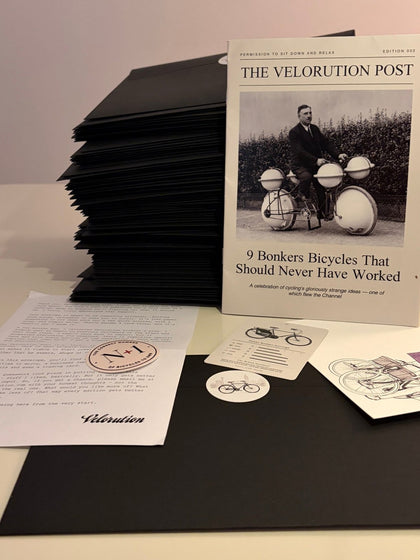
The Velorution Post
Real mail. Once a month.
We're all a bit digitally overwhelmed. So once a month I hand-pack an envelope and post it to you — a 16-page mini magazine, a letter, a collectable card. Things worth keeping, not junk through the door.

The Velorution Post
My pride and joy, through your letterbox
A 16-page mini magazine every month. No ads, just bicycle love. In the envelope with it:
- A letter from me
- A collectable trading card
- My real numbers, warts and all
And the appetite is there. In the 2023 Walking and Cycling Index, 31% of Birmingham residents said they don't cycle but would like to, and 56% supported more separated cycle paths, even if it meant less room for other traffic.
The complication is that fewer Birmingham adults cycle regularly now than before the blue routes opened, according to the government's Active Lives survey:
| Adults cycling… | 2016–18 | 2019 | 2023 |
|---|---|---|---|
| At least once a month – Birmingham | 12.7–13.6% | 8.9% | 7.8% |
| At least once a month – England | 16.1–17.1% | 16.1% | 14.7% |
| At least once a week – Birmingham | 9.0–9.9% | 6.7% | 5.4% |
| At least once a week – England | 11.5–11.9% | 11.2% | 10.1% |
The margins on a survey like this are wide, so I wouldn't read much into any single year. But the drop since 2016–18 is bigger than those margins, and so is the gap with the rest of England. No newer local figures have been published, so 2023 is the latest there is.
The Index explains some of it. Only 35% of residents think cycling safety in their area is good, and only 7% of women cycle weekly, against 17% of men. Those are exactly the people the A38 and A45 have to win over.
There have been setbacks too. In Kings Heath, the next phase of the low-traffic neighbourhood has been sent back for revision and will now be built in separate packages, each needing its own approvals and consultation. And the campaigners are honest about quality. Push Bikes reviewed the new Dudley Road cycleway and found what's been built "very good", but criticised the stretch where people walking and cycling are "expected to share the pavement outside shop doors" so that the road can keep four lanes of traffic.
Put together, I think the picture is fairly clear. Birmingham is building for everyday cycling faster than at any point since 2019, but most of the people it's building for are still waiting until it feels safe enough to ride, and the crowd in Victoria Square made that plain.
What London can learn from Brum
London painted its first Cycle Superhighways blue too, and learned the hard way that paint isn't protection. Birmingham's blue routes, on the other hand, were segregated from day one.
The Kings Heath row will sound very familiar to anyone who lived through the low-traffic neighbourhood fights in Walthamstow or Ealing.
The A38's central-reservation design is the part I'd most like London's boroughs to study. Nearly every corridor fight in the capital comes down to whose lane gets taken, and Bristol Road South avoids most of that by using the grass in the middle. London has a few wide, split roads like that too.
Some modesty is in order, though. Hackney, where 29% of adults cycle at least once a week, has had a decade's head start, and outer London looks a lot more like Birmingham than Hackney, so it faces the same choices. I wrote about how London's politics on this flipped at the ballot box in May.
Back to the square
Adam from Stourbridge said it best, riding with his daughter among a few thousand strangers: "If only it could be like this all the time."
The A38 extension and the A45's second phase are how Birmingham gets closer to "all the time": a blue line down the middle of Bristol Road South, and a protected lane past the shops of the Coventry Road for people who were never going to own a car.
So the dates to watch are the A38's Traffic Regulation Order consultation later this year, the combined authority's decision on the A38's funding, and the first spades in the ground in 2027.
Top image: the A38 blue route down the central reservation of Bristol Road, Edgbaston, June 2019. IMAGE CREDIT: Tom Axford, CC BY-SA 4.0, via Wikimedia Commons
Leave a comment
No comments yet — be the first.

Velorution Exclusive · October
Define Bicycle Mug
£18.00. One month only. Then it retires to the Velorution Vault and may never be seen again.
Get it before it's goneFrom the Collective


More stories


