
Latest Stories
The Year Bike Lanes Started Winning Elections

Last week I wrote about bike lanes designed to stop you cycling — the barriers, the £2.7 million removals, the lanes that flip between protected and painted depending on who won the last election.
That last part was the real disease. A bike lane is a long-term bet that changes behaviour over years, and elections happen every four or five. For most of my cycling life, the safe political move has been to rip the things out.
So here's the good news I promised: in London, that political logic just flipped. In May's local elections, bike lanes didn't just survive the ballot box. They won it.
What actually happened in May
Before the 2026 London borough elections, the London Cycling Campaign — 12,000 members strong — asked every council to sign its Streets for Cycling pledge: a commitment to deliver every cycling corridor TfL has identified in their borough by 2030.
Not "look into it". Not "conduct a feasibility study". Deliver the network, on a deadline, to a measurable standard — because the schemes only unlock TfL funding if they meet TfL's Cycle Route Quality Criteria. No paint-and-pray lanes, no barrier slaloms.
When the results came in, LCC counted more than fifteen boroughs — returning Labour councils, new Green ones, and several with no overall control — now committed to rapid delivery of their cycle networks, with Ealing, Harrow, Kingston and Merton expected to keep building alongside them. That's roughly half of London signed up to finish the map within four years.
Read that sentence with 2020 eyes and it's barely believable. Six years ago, Kensington & Chelsea removed a £700,000 protected lane after seven weeks rather than let its own trial produce data. Now councils put cycle networks in their manifestos — and win on them.

Everyday riders, ordinary clothes — the whole point of a network. IMAGE CREDIT: London Cycling Campaign (lcc.org.uk)
Why the politics flipped: the numbers got too big to argue with
Politicians didn't suddenly fall in love with bicycles. The electorate did — and the data made it undeniable.
Start with the network itself. In 2016, London had 90km of strategic cycle routes. Today it's well over 400km — the network has grown five-fold in a decade. In the 2023/24 year alone, TfL launched twenty new Cycleways, connecting more than 600,000 Londoners to the network. Over a quarter of Londoners (27.4%) now live within 400 metres of a cycle route, and the Mayor's target is 40% by 2030 — which is precisely what those borough pledges exist to deliver.
And people are using it. TfL's counts put daily cycle journeys at 1.33 million a day — up 26% on 2019, with central London growing 11.6% in a single year. As LCC's chief executive Tom Fyans points out, that's equivalent to about a third of all Tube journeys, made on bicycles, every day.
Urban cycling news, honest stories, and a front-row seat as we rebuild Velorution from scratch. Free, every week.
Join 40,000+ following along
The Square Mile is the picture in miniature: the City of London counted 139,000 cyclists in a single day — 56% of all peak-hour traffic, with bikes now outnumbering cars nearly two to one. I wrote up the full City story back in April if you want the deep dive.
Here's the political translation of all those numbers: a decade ago, the people objecting to a bike lane outnumbered the people using it. Now it's the other way round. 1.33 million daily journeys is 1.33 million daily voters with a direct, personal stake in the network — and councillors can count.
The holdouts
It wasn't a clean sweep, and it's worth being honest about the map's grey areas.
Westminster's new Conservative leadership is threatening legal action against the Oxford Street pedestrianisation and opposed several cycling schemes before the election. Newham's mayor campaigned on free parking for first cars and declined to sign the pledge. Tower Hamlets and Kensington & Chelsea — the borough of the seven-week cycle lane — remain what LCC diplomatically calls the usual suspects. And Havering is now controlled by Reform, whose position on cycling infrastructure is, charitably, unwritten.
But look at what the holdout list tells you: it's now short enough to name. The argument that needed winning borough by borough is won in most of them — the remaining fights are specific, local and countable on one hand with a finger spare.

The measure of a network: whether people ride it in their own clothes, at their own pace. IMAGE CREDIT: London Cycling Campaign (lcc.org.uk)
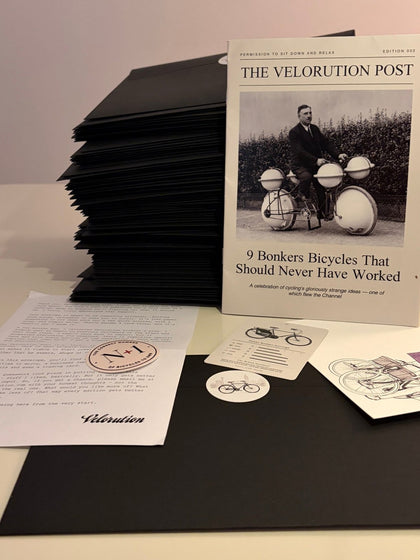
The Velorution Post
Real mail. Once a month.
We're all a bit digitally overwhelmed. So once a month I hand-pack an envelope and post it to you — a 16-page mini magazine, a letter, a collectable card. Things worth keeping, not junk through the door.

The Velorution Post
My pride and joy, through your letterbox
A 16-page mini magazine every month. No ads, just bicycle love. In the envelope with it:
- A letter from me
- A collectable trading card
- My real numbers, warts and all
Continuity, and nerve
Last week I said the places that get cycling right — Paris above all — didn't build anything spectacular. They built boring, continuous, direct routes and then refused to rip them out when the grumbling started. Continuity, and nerve.
That's why May matters more than any individual lane. The nerve is now institutional. The corridors are mapped by TfL. The funding is attached to a quality standard, so the barrier-slalom compromise lane doesn't qualify. And the delivery deadline — 2030 — now sits inside the electoral commitments of half of London's councils, which means removing a route has gone from a cheap political win to a broken manifesto promise.
Build-remove-rebuild was the election cycle drawn in thermoplastic paint. What London voted for in May is the other thing: a network that outlives the argument about it.
What you can do (yes, you)
If you're in London: find out whether your borough signed the Streets for Cycling pledge. If it did, hold it to the 2030 deadline — pledges rust quickly without residents pointing at them. If it didn't, LCC's local groups are exactly the lever for that, and membership starts at less than a coffee a month.
If you're not in London: this is the playbook. A published map of corridors, a quality standard attached to the money, and a deadline politicians have to put their name to. It travelled from Paris to London. It travels further.
And if all these new kilometres of Cycleway finally tempt you (or someone you love) onto two wheels for the commute — start with your head. The Dashel ReCycle helmet in our Collective is made in Britain from recycled plastic, and it's the one I'd buy first.
Leave a comment
No comments yet — be the first.

Velorution Exclusive · October
Define Bicycle Mug
£18.00. One month only. Then it retires to the Velorution Vault and may never be seen again.
Get it before it's goneFrom the Collective


More stories

