
Latest Stories
From the Mini to the Moulton: A Classic British Story

In the old Velorution shops, among the cargo bikes and the belt-drive commuters, you'd find a Moulton. It was exactly the kind of bike Velorution existed to sell: beautiful, unusual, and designed by someone who refused to accept that a bicycle had to look the way bicycles had always looked.
A lot of you have asked about it. So here's the full story.
Designed by the man behind the Mini
Most clever bikes are designed by bike people. The Moulton wasn't. It was designed by the man who made the Mini ride smoothly.
Dr Alex Moulton was a suspension engineer from an engineering family. His most famous work had nothing to do with bicycles. He designed the rubber-cone suspension for the original Austin Mini, working alongside his friend Sir Alec Issigonis. It's a large part of why that tiny car rode the way it did.
Then he turned the same eye on the bicycle and decided most of it was wrong.
He once pointed out that the car was an almost inevitable evolution from the horse-drawn carriage, but the bicycle, balancing a human on a single track, was a far stranger and more unlikely thing to have invented. He thought it had been left half-finished. So he set out to finish it.

IMAGE CREDIT: MOULTON BICYCLES
Small wheels and a heretical idea
Partly prompted by the fuel shortages of the 1956 Suez crisis, Moulton began work on a small-wheeled bicycle. The first one launched at the Earls Court Cycle Show in 1962.
The idea was simple and slightly heretical for the time. Small wheels for agility and a low centre of gravity. Full front and rear suspension for comfort. And a frame that threw out the traditional diamond shape entirely, built instead around a distinctive open "F" design with no top tube, so you could step on and off without swinging a leg over.
What he was chasing was a specific feeling. A bike that stayed rigid when you pushed hard on the pedals, but soaked up the broken road surface underneath you. Stiff where you want it, soft where you don't. He believed he'd found the holy grail of bicycle design, and a lot of people who've ridden one agree with him.

IMAGE CREDIT: MOULTON BICYCLES
Urban cycling news, honest stories, and a front-row seat as we rebuild Velorution from scratch. Free, every week.
Join 40,000+ following along
Nearly killed by the bike industry
Being right is not the same as winning. Moulton had the patents, but he didn't have the marketing muscle of the big manufacturers. He licensed the design to Raleigh, who built it for a few years and then dropped it. Rivals copied the eye-catching small wheels while quietly leaving off the suspension that actually made the thing work, which gave small-wheeled bikes a slightly poor reputation they didn't deserve.
So in the early 1980s, Moulton reopened his own factory at Bradford-on-Avon and built the bike he'd wanted all along. The AM. Its frame is an intricate tubular lattice, a "spaceframe", lighter and stiffer than a conventional diamond frame and unlike anything else on the road. Introduced in 1983, it's the bike some people will quietly tell you is the best bicycle ever made. Full stop.
The same thinking spread. The AM-ATB of 1988, a rugged spaceframe Moulton on slightly larger wheels, is often described as one of the first full-suspension mountain bikes. Decades before suspension became standard, Moulton was already there.
A few things people get wrong
The most common one: people assume a Moulton folds like a Brompton. It doesn't. It separates. The frame splits cleanly into two parts for transport or storage, which is a different and arguably more elegant trick than folding. It paved the way for the folders that came later, but it was never trying to be one.
The second: people assume it's a budget runaround because of the little wheels. It's the opposite. Moultons are hand-built in Britain in tiny numbers, largely to custom order, at prices that run well into the thousands. This is a bike you spec, not one you grab off a rack.
It has the fan club to match. James Dyson rides one. The architect Sir Norman Foster called Moulton a brilliant engineer. In Japan, where good design tends to be recognised early, the Moulton has long had something close to a cult following. As with so many of the bikes we love at Velorution, like the Strida, it took the rest of the world a while to catch up.
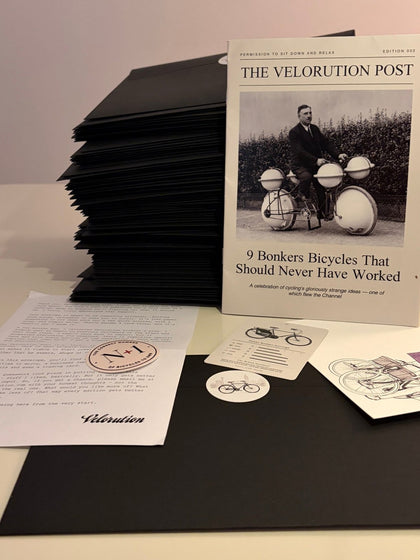
The Velorution Post
Real mail. Once a month.
We're all a bit digitally overwhelmed. So once a month I hand-pack an envelope and post it to you — a 16-page mini magazine, a letter, a collectable card. Things worth keeping, not junk through the door.

The Velorution Post
My pride and joy, through your letterbox
A 16-page mini magazine every month. No ads, just bicycle love. In the envelope with it:
- A letter from me
- A collectable trading card
- My real numbers, warts and all

Still being made
Alex Moulton died in 2012, but the bike outlived him. The premier machines are still designed and hand-built in Britain, at the same Bradford-on-Avon home, carrying on the same small-wheel, fully-suspended philosophy he set out more than sixty years ago. If you want to fall down the rabbit hole properly, the Moulton Bicycles website is the place to start.
It's less a commuter bike than a piece of British engineering you happen to be able to ride. Which is exactly why it belonged in a Velorution store, and exactly why it's worth knowing about now.
Do you own a Moulton, or did you buy one from Velorution back in the day? Reply and tell us about it. We'd love to feature your story.
Leave a comment (3)

Velorution Exclusive · October
Define Bicycle Mug
£18.00. One month only. Then it retires to the Velorution Vault and may never be seen again.
Get it before it's goneFrom the Collective


More stories


Tim · 8 June 2026
Obviously I meant “article” not “tarticle”… but the original email was quite tasty to be fair
Tim · 6 June 2026
Nice tarticle about the Moulton. Back in the ’80’s I worked at Rohan, the travel clothing company, which had a tie-up with Moulton briefly. We were cool in those days… Anyway, I managed to acquire a demonstrator AM14 in lieu of a bonus one year, which was quite something. This was pressed into service for numerous Audaxes and lots of fast day riding. Scarcity of components was one reason to sell this about 20 years later – for example, there’s now only 1 supplier of tyres for those 17" wheels I think, and the bespoke cassette was pretty pricey. But the good news is – in possibly a vain attempt to recapture my youth – I’ve just bought an SST. This is the posher version of the entry level TSR, both now with regular 20" wheels. Having been to the factory in Bradford-upon-Avon in the past, and even had a couple of “audiences” with SIr Alex himself, it’s nice to be back in the world of Moulton. The bike is a little bit on the hefty side by todays standards (there’s a lot of tubing in there), but the very narrow tyres and very smooth suspension give the bike it’s own distinctive and engaging ride. Funnily enough, it turns out Sir Alex was probably wrong back in the ’60’s about the need for really skinny, high pressure tyres, and hence suspension (this may be heresy…!). But the bike is a triumph of engineering, a beauty to behold, lovely to ride, and tends to prompt lots of attention. As well as constant questions: “is that a Brompton?”, “is that a Bickerton?” or, my particular favourite: “did you build that yourself??”!
Graham · 6 June 2026
I have 3 – two early 1960s machines and a continuously upgraded 1992 AM. They do polarise opinions. If you know, you know, as they say. The Velorution link I’d that I bought a day bag from the business – shortly after they closed down 🙁. I hope it wasn’t my fault!