
Latest Stories
The Royal Mail is Bringing Back the Post Bike

Last month, Royal Mail did something quietly momentous: it put bicycles back on the round.
Twenty of them, to start — electric cargo cycles rolling out in London, Brighton and Cambridge. Which might not sound like much, until you remember that in 2014 Royal Mail scrapped its bikes entirely, ending well over a century of post arriving by pedal.
This is the story of how Britain built the greatest postal bike fleet in the world, killed it while the rest of Europe was pedalling hard in the opposite direction, and — twelve years later — realised it needed it back.

IMAGE: WIKIMEDIA COMMONS
One hundred bicycles
The Post Office bought its first 100 bicycles in 1896. Before that, postmen had been quietly using their own machines for years — by 1895 there were 67 "cycle posts" running on riders' own bikes and tricycles — but 1896 was the year the bicycle officially joined the payroll, largely because the free telegram-delivery radius had just been extended from one mile to three, and nobody fancied walking it.
From there the bicycle didn't just join the postal service. It became it. In 1929 the Post Office standardised its bicycle into a single specification — steel frame, rod brakes, and a distinctive kink in the top tube so shorter posties could actually get a leg over. That basic machine, in pillar-box red to match the vans and the postboxes, served for the better part of sixty years.
The Pashley years
For decades, those bikes came from one place: Pashley, in Stratford-upon-Avon — the same family firm whose 100th birthday I wrote about a few issues back.
At its height, Royal Mail ran what was widely described as the largest bicycle fleet in the western world — around 24,000 bikes when the end began, with Pashley having supplied more than 75,000 machines over the years. In 1999 Royal Mail ran a Europe-wide competition to design the next-generation postal bike. A British firm won it anyway: Pashley's "Pronto", which entered service in 2000 as the Mailstar.

The Pashley Mailstar. IMAGE: THE POSTAL MUSEUM / WIKIMEDIA COMMONS
The Mailstar was a serious piece of engineering dressed as a humble sit-up-and-beg. A 23kg step-through steel frame rated to carry 32kg of mail. Three-speed hub gears, drum brakes, and one genuinely clever detail: the front rack bolts to the frame, not the fork — so a full load of letters doesn't swing about when you turn the bars. Anyone who's ridden a wobbly basket-on-the-handlebars shopper will appreciate what a difference that makes.
The end of the road
Then, in 2010, Royal Mail started taking the bikes away.
The official reasons were twofold: safety — 576 bike-related incidents and 2,748 lost working days in 2010–11 — and the changing shape of the post itself. We'd all started shopping online. Parcels were getting bigger and heavier, letters fewer, and a pannier only holds so much. Posties got high-capacity trolleys — "golf trolleys", inevitably — and more vans.

Mailstars in Guildford, before the end. IMAGE: WIKIMEDIA COMMONS
Not everyone bought it. The CTC (now Cycling UK) publicly disputed the safety rationale, and critics pointed out that the remaining bikes had gone years without a proper spares and maintenance budget — which is one way to make a fleet look unsafe. But the direction was set. By 2014 the last red Mailstars were withdrawn, and post by bike in Britain was over.
Urban cycling news, honest stories, and a front-row seat as we rebuild Velorution from scratch. Free, every week.
Join 40,000+ following along
Meanwhile, on the Continent…
Here's the part that makes the 2010 decision look less like modernisation and more like a wrong turn. While Royal Mail was loading its bikes into skips, virtually every major postal service in Europe was buying more of them — they'd simply worked out that the answer to heavier post was electric assistance, not a diesel van.
- France: La Poste started deploying its Staby electric three-wheelers in 2014 — the very year Royal Mail's last bike was withdrawn — and today runs 18,000 electric bikes, within a maintained fleet of some 55,000 bicycles. One of the largest e-bike fleets on Earth, delivering letters.
- Germany: Deutsche Post DHL put its 1,000th e-cargo bike into service in 2017, and by 2021 was running around 17,000 e-bikes and e-trikes — with plans to more than double that.
- Netherlands: PostNL has run electric delivery bikes since 2017 and hit emission-free delivery in every Dutch inner city from 1 January 2025, with 500-plus electric cargo trikes in Amsterdam alone.
- Switzerland: Swiss Post delivers with around 6,300 electric two- and three-wheelers — the last petrol scooter is long gone.
- Scandinavia and Austria: PostNord runs roughly 5,000 electric bikes, mopeds and light EVs; Austrian Post has bought nothing but zero-emission delivery vehicles since 2022.
Same parcels. Same e-commerce boom. Opposite conclusion.
The elephant in the room
Here's the bit of the story I love most. Those thousands of retired Mailstars didn't go to the scrapyard.
A Staffordshire charity, the Krizevac Project, took on around 5,000 of them, refurbished them, and sold them as the "Elephant Bike" — £250 each, and for every one sold in the UK, another was shipped to their social enterprise in Malawi.
Why "Elephant"? As the charity tells it: park wardens in Malawi's Liwonde National Park used ex-Royal Mail bikes to patrol a rhino sanctuary fence, and the local elephants took exception to Post Office red. The fleet got resprayed in bush-friendly green, and a name was born.
The false starts
In fairness, Royal Mail did have a couple of goes at this before now.
In March 2019 it quietly put eight electric trikes on rounds in Stratford, Cambridge and Sutton Coldfield for a six-month trial. Clever machines, too: 250-watt pedal assist, regenerative braking, and two solar panels on the cargo-box roof trickling charge into the battery between doors. Royal Mail never said who built them — only that they were Italian-made and already proven at GLS, Royal Mail's own European parcels arm, which had been happily running cargo trikes around Italian cities for years. The trial ended that autumn, and then… nothing. No verdict, no rollout, no trikes. Publicly at least, that was that.
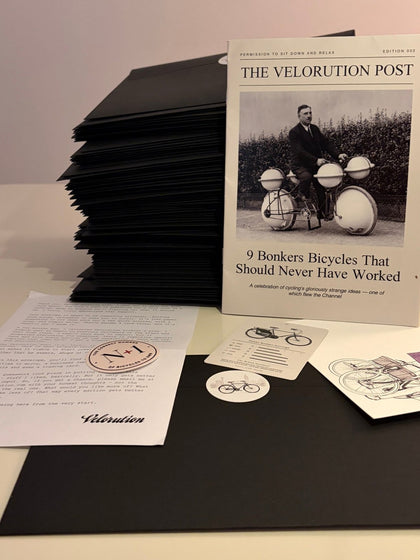
The Velorution Post
Real mail. Once a month.
We're all a bit digitally overwhelmed. So once a month I hand-pack an envelope and post it to you — a 16-page mini magazine, a letter, a collectable card. Things worth keeping, not junk through the door.

The Velorution Post
My pride and joy, through your letterbox
A 16-page mini magazine every month. No ads, just bicycle love. In the envelope with it:
- A letter from me
- A collectable trading card
- My real numbers, warts and all
Then in autumn 2021 came a six-month trial of micro electric vehicles — a dozen golf-buggy-sized machines, the Norwegian Paxster Cargo and the French Ligier Pulse 4, tested in Edinburgh, Crewe, Liverpool, Swindon and London. No pedals this time, so not strictly a bike story. But that's the one test that stuck: by November 2025 Royal Mail was running more than a hundred of them, replacing 52 vans in London, Bristol, Newcastle-under-Lyme and Brighton. The pedals, though, still had to wait.
The comeback
Which brings us to July 2026, and a company called Minimal.
Founded by two ex-Arrival engineers — CEO Patrick Bion was previously on Tesla's Model S, X and 3 design team — Minimal builds its Pedal 4 electric cargo cycle in a microfactory in Park Royal, West London. Royal Mail has taken the first 20, for rounds in London, Brighton and Cambridge, with more locations planned.
The spec sheet tells you exactly why the bike is back:
- 2.5 cubic metres of cargo — the Mailstar carried 32kg in panniers
- Up to 37 miles of range, charged from an ordinary plug
- No driving licence required
- Legal on roads up to 30mph, plus cycle lanes, paths and greenways
"Our new electric cargo cycles mark another important step towards reaching Net-Zero by 2040," said Mark Riley, Royal Mail's Delivery Design Manager, "…while creating new opportunities for people to join Royal Mail without needing a driving licence."
And there's the punchline. Royal Mail scrapped the bicycle because parcels got too big for it. The French, the Germans and the Dutch looked at exactly the same parcels and built bigger bikes. Twelve years on, Royal Mail has finally agreed with them.
The post bike is dead. Long live the post bike.
I still send post by bike myself, incidentally — The Velorution Post goes out on the 10th of every month.
Leave a comment
No comments yet — be the first.

Velorution Exclusive · October
Define Bicycle Mug
£18.00. One month only. Then it retires to the Velorution Vault and may never be seen again.
Get it before it's goneFrom the Collective


More stories

