
Latest Stories
Schindelhauer: The Berlin Bikes That Ditched the Chain

Long before I had anything to do with the Velorution name, I used to wander into the old shop on Great Titchfield Street like everyone else: to look at bikes I had no sensible reason to buy.
One marque stopped me in my tracks every single time. Schindelhauer. Clean lines, deep colours, nothing on the frame that didn't need to be there — and, if you looked closely, no chain. I've wanted one ever since. It's been sitting stubbornly on my bucket list for years.
The story of how those bikes came to exist deserves telling properly.
The student project that ditched the chain
In the late 2000s, four students at Otto von Guericke University in Magdeburg — Manuel Holstein, Martin Schellhase, Jörg Schindelhauer and Stephan Zehren, between them covering mechanical engineering, industrial design and business — started working on an idea most of the bike industry had long written off: getting rid of the bicycle chain.
The chain is a brilliant piece of Victorian engineering, but it has never stopped being a Victorian piece of engineering. It rusts. It stretches. It needs oil, and it shares that oil generously with your right trouser leg.
What began as a university project turned into a company — c2g-engineering GmbH, founded at the end of 2008. By spring 2009 the first prototype was ready, and they presented it at Eurobike, the industry's biggest trade show, that summer. Schindelhauer Bikes was born.

IMAGE CREDIT: SCHINDELHAUER BIKES
Why the belt needed a whole new bike
The technology they bet everything on was the Gates Carbon Drive: a polyurethane belt reinforced with carbon fibre cords, borrowed from motorcycles and industrial machinery. No oil. No rust. Near-silent. Schindelhauer puts its service life at roughly double that of a chain — with essentially zero maintenance in between.
Here's the catch, and the reason nobody had properly committed to it before: a belt can't be split and rejoined the way a chain can. You can't retrofit one onto a normal frame — the frame itself needs an opening engineered into the rear triangle so the belt can pass through, and the whole drivetrain has to hold a dead-straight line under constant tension. Derailleurs are out entirely; belt-drive bikes run singlespeed, internal hub gears or gearbox drives instead.
Most manufacturers treated all that as a reason not to bother. The Magdeburg four treated it as a design brief. Schindelhauer became the first bicycle manufacturer in the world to develop its frames from the ground up around the belt — every model, from the very first prototype. No chain option. No hedging. Their own line says it plainly: belt-driven, since day one.
A name that means craftsman
The brand name came from co-founder and product manager Jörg Schindelhauer — partly because it was distinctive, partly because of what it means. A Schindelhauer is an old German trade name for a shingle-maker: someone who splits and shapes wooden roof tiles by hand, one at a time. For a company obsessed with doing one thing precisely, it could hardly fit better.
Urban cycling news, honest stories, and a front-row seat as we rebuild Velorution from scratch. Free, every week.
Join 40,000+ following along
At the end of 2012 the company moved from Magdeburg to Berlin, settling on Schlesische Straße in Kreuzberg, near the Spree — where design, component development and final assembly still happen today. The recognition came steadily: a Eurobike Award in 2011, a Red Dot "Best of the Best" in 2014. And in a detail I enjoy far too much, every single Schindelhauer employee commutes to work by bike.

The Viktor, Schindelhauer's purist singlespeed - IMAGE CREDIT: SCHINDELHAUER BIKES
Bikes named like grandparents
Schindelhauer doesn't do model numbers. It does first names — proper German ones, the kind you'd find in a pre-war family album.
Viktor is the purist's singlespeed. Ludwig runs Shimano's Alfine hub gears, with Lotte as his step-through counterpart. There's Friedrich and Frieda, Gustav and Greta, Hektor and Siegfried, Wilhelm the all-road bike, and Emil and Emilia with Pinion gearbox drives. In 2019 — ten years in — the company added its first four e-bikes, city commuter machines that today go by names like Arthur, Heinrich and Hannah. Belt-driven, naturally.
Prices start at €1,750 for the simplest city bikes and climb comfortably past €5,000 for a Rohloff-equipped or automatic-shifting flagship. Not cheap. But nothing about a Schindelhauer is trying to be cheap — that's rather the point. This is the bike as a considered object: something you buy once, ride daily in normal clothes, and never oil.
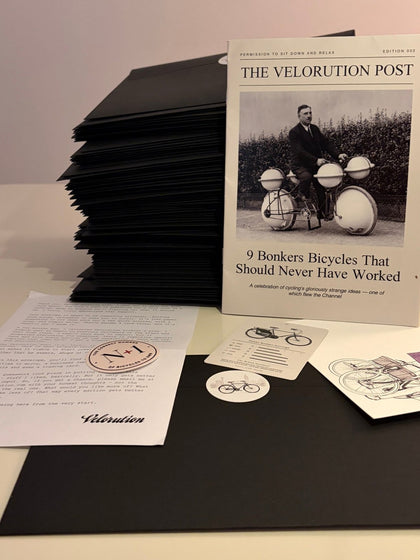
The Velorution Post
Real mail. Once a month.
We're all a bit digitally overwhelmed. So once a month I hand-pack an envelope and post it to you — a 16-page mini magazine, a letter, a collectable card. Things worth keeping, not junk through the door.

The Velorution Post
My pride and joy, through your letterbox
A 16-page mini magazine every month. No ads, just bicycle love. In the envelope with it:
- A letter from me
- A collectable trading card
- My real numbers, warts and all

The Ludwig in graphite black - IMAGE CREDIT: SCHINDELHAUER BIKES
The one that got away (so far)
Which brings me back to Great Titchfield Street. The old Velorution stocked exactly this kind of machine — it's where I first ended up nose-to-head-tube with a Schindelhauer, and where the bucket-list entry got written.
Sixteen years after four students in Magdeburg decided the chain's time was up, the bikes are still made the same way, in the same Kreuzberg building, under a shingle-maker's name. Some ideas just need someone stubborn enough to build the whole bike around them.
One day, Ludwig. One day.
Sources
Leave a comment (1)

Velorution Exclusive · October
Define Bicycle Mug
£18.00. One month only. Then it retires to the Velorution Vault and may never be seen again.
Get it before it's goneFrom the Collective


More stories


Matthew · 31 July 2026
Great piece, Pete! I’d been cycling on a Specialized for 22 years and needed a change. It was love at first sight for me too when I saw the Schindelhauers at Velorution on Great Portland Street 5 years ago and I bought an 11 speed Ludwig on the spot. It’s an absolutely stunning bike and people still stop me to ask about it.
A car ran into me 6 months ago in Dulwich where I live. It sent me flying and I smashed the windscreen and hit the road hard, breaking a bone in my hand. Luckily the Schindelhauer only suffered a small ding on the top tube and as it’s an alu pure version it doesn’t show up too much :)
I was very sad to hear the shops closed, but you’re doing a magnificent job at giving the brilliant Velorution name another life.
Matthew