
Buying Guides
Brompton C Line vs P Line: Is Saving 1.5kg Worth an Extra £1,000?

There is a moment in every Brompton purchase where the sums stop making sense. You have decided you want one. You have worked out roughly which gearing suits your hills. And then you notice that the same bike, in a lighter frame, costs a thousand pounds more.
That is the C Line versus P Line question, and it is remarkably consistent. C Line 4-speed is £1,399, P Line 4-speed is £2,399. C Line 12-speed is £1,599, P Line 12-speed is £2,599. Whichever gearing you choose, the upgrade to titanium costs exactly £1,000.
What you get back is between 1.23kg and 1.44kg. I want to be honest with you about whether that is a good trade, because for some people it obviously is and for most people it obviously isn't — and the marketing is not going to tell you which camp you're in.
The weights, exactly
These are Brompton's own from-weights, read off brompton.com in August 2026. Real-world weights vary with handlebar type, seatpost, mudguards and whatever you've bolted on since.
- C Line 4-speed: 11.3kg
- P Line 4-speed: 9.86kg — a saving of 1.44kg
- C Line 12-speed: 12kg
- P Line 12-speed: 10.77kg — a saving of 1.23kg
Two things jump out. First, the P Line 4-speed is the only Brompton in the main range that sneaks under 10kg, and Brompton know it — 9.86kg is a number chosen to have a 9 at the front. Second, the saving is smaller at 12-speed. The 12-speed drivetrain adds a derailleur, a longer cage and a heavier rear frame to both bikes, which eats into the titanium advantage. You pay the same £1,000 and get 210 fewer grams for it.

IMAGE CREDIT: Brompton
The full comparison
All four non-electric variants of the two lines, side by side. Prices are brompton.com RRP.
| C Line 4-speed | C Line 12-speed | P Line 4-speed | P Line 12-speed | |
|---|---|---|---|---|
| Price from | £1,399 | £1,599 | £2,399 | £2,599 |
| Weight from | 11.3kg | 12kg | 9.86kg | 10.77kg |
| Frame | Steel | Steel | Titanium / aluminium / steel / carbon mix | Titanium / aluminium / steel / carbon mix |
| Gears | 4 | 12 (3-speed hub × 4-speed derailleur), 402% range | 4 | 12 |
| Wheels | 16" | 16" | 16" | 16" |
| SuperRoll+ version | — | — | £2,479, 10kg | £2,679, 10.87kg |
| Cost of the weight saved | n/a — this is the baseline | n/a — this is the baseline | £1,000 for 1.44kg (69p/g) | £1,000 for 1.23kg (81p/g) |
| Frame warranty | 7 years if registered | 7 years if registered | 7 years if registered | 7 years if registered |
What the titanium actually buys you
The P Line is not a titanium bike. This matters, and it's the single most misunderstood thing about it. The main frame — the big triangle with the hinge in it, the part that takes the load — is still steel, hand-brazed in Greenford like every other Brompton. What's titanium is the rear frame and the fork. The rest is a mix of aluminium and, in places, carbon.
So the P Line is a C Line with its two heaviest bolt-on structures swapped for lighter ones, plus a lighter drivetrain and a few weight-shaved components. That's where 1.2–1.4kg comes from. It is not a fundamentally different bicycle, and anyone telling you it rides like one is describing a placebo.
Here is the thing that decides it. That saving is almost entirely invisible while you're riding. On a 16" wheeled bike with a rider on top, 1.4kg is roughly 1.5% of the total moving mass. You will not feel it on the flat. You might notice it on a steep climb if you're paying attention. Nobody has ever got home from a commute and thought, well, that was 1.44kg better.
Where you absolutely do feel it is carrying the bike folded. And that is a completely different physical act — you're lifting the whole thing, one-handed, usually while also holding a bag, usually while tired, usually up something.

IMAGE CREDIT: Brompton
The carry test
Forget cost per gram for a second and count carries instead. How many times a week do you actually pick your folded Brompton up and hold it?
Not wheel it. Not park it. Lift it. Station stairs where the lift is broken. The gap between platform and carriage. Getting it onto a luggage rack. Up two flights to a flat with no lift. Into the boot of a car. Onto the scales at an airport check-in desk.
If the answer is once or twice a week, buy the C Line and spend the thousand pounds on something you'll notice — a good lock, a Brooks saddle, the luggage system, a year of proper servicing, and a very great deal of coffee.
If the answer is six times a day, every working day, the arithmetic inverts entirely. Someone doing a two-leg train commute with a walk at each end is lifting that bike around 1,500 times a year. Across the seven-year registered frame warranty that's over 10,000 lifts. Take 1.44kg off each one and you have removed roughly 15 tonnes of lifting from your shoulders and lower back over the life of the bike. Put like that, £1,000 starts to look like an ergonomics purchase rather than a vanity one.
That's the honest split. The P Line isn't for people who ride a lot. It's for people who carry a lot. Those are not the same customer, and Brompton's own photography does a poor job of distinguishing between them.
Cost per gram, without flinching
Let's do the ugly version of the maths, because I think it clarifies things.
- At 4-speed: £1,000 ÷ 1,440g = 69p per gram
- At 12-speed: £1,000 ÷ 1,230g = 81p per gram
Two conclusions follow. The first is that if you have already decided you want a P Line, the 4-speed is the better-value one. You get 17% more weight saving for the same thousand pounds. The 12-speed upgrade is the weaker deal of the two, which is slightly awkward given that 12-speed is the gearing most people now want.
The second is that this is genuinely expensive weight, but it isn't outrageous by the standards of the wider bike industry — where people cheerfully spend four figures to take 200g off a set of wheels. What makes the Brompton version defensible is that the weight comes off a thing you physically pick up, which is not true of almost any other bicycle.
One more figure worth holding in your head. Skipping the P Line upgrade and buying a C Line 12-speed instead of a P Line 12-speed leaves you £1,000 in credit — which is most of the way to a second Brompton, or an entire A Line with change. I've written about that end of the range in Brompton A Line vs C Line, and the same logic runs through the whole ladder: every rung costs real money for a benefit that shrinks the further up you go.
SuperRoll+, and the small print on it
Both P Lines come in a SuperRoll+ version, and this is where the weight story gets slightly funny.
SuperRoll+ gives you the roller frame — larger, better rollers so the folded bike wheels along beside you properly rather than skittering about on tiny castors. It costs £80 on top, and it adds weight back:
- P Line SuperRoll+ 4-speed: £2,479, 10kg — you've just paid £80 to put 140g back on and lose your sub-10kg headline
- P Line SuperRoll+ 12-speed: £2,679, 10.87kg — £80 for 100g back
Which sounds absurd until you think about it for ten seconds, at which point it becomes the most sensible option in the range. If your problem is moving the folded bike around, rolling it beats carrying it every single time. A bike you can wheel through a station concourse is worth far more to you than 140g.
Urban cycling news, honest stories, and a front-row seat as we rebuild Velorution from scratch. Free, every week.
Join 40,000+ following along
My view: if you're spending P Line money because of the carrying, spend the extra £80 too. Rolling solves more of the problem than shaving does. The only reason not to is if you want the 9.86kg number for its own sake, and I'd gently suggest that's not a reason.
Worth knowing: in the UK the P Line is widely stocked in its Roller Frame form rather than the plain version, so the SuperRoll+ prices are frequently the ones you'll actually be quoted.
IMAGE CREDIT: Brompton
The four bikes, and who each one is for
Brompton C Line 4-speed — the sensible one
£1,399, 11.3kg. Steel frame, mudguards, front carrier block, folding left pedal, and the full colour range. Four gears is plenty for a flattish city and the hub-and-derailleur simplicity means less to think about. This is the Brompton most people should buy and then never think about again for a decade. Not for you if you live somewhere properly hilly, or if you carry the bike constantly.
IMAGE CREDIT: Brompton
Brompton C Line 12-speed — the one most people should buy
£1,599, 12kg. Introduced in 2025 when the old 6-speed was retired, and it brought a new rear frame with it. A 3-speed hub multiplied by a 4-speed derailleur gives 12 ratios and a 402% range, which is more spread than most people will ever need and exactly right if your route has anything resembling a hill in it. £200 for that is the best-value upgrade anywhere in the Brompton range. It costs you 700g over the 4-speed. Take it.
IMAGE CREDIT: Brompton
Brompton P Line 4-speed — the lightest sensible Brompton
£2,399, 9.86kg — or £2,479 and 10kg for the SuperRoll+ Roller Frame version linked here, which is the one commonly in stock. Titanium rear frame and fork, and the best pound-for-gram deal in the P Line. For the daily carrier on a flat-ish route who wants the lightest thing that isn't a T Line. Not for you if you have hills, because four gears plus a light frame still doesn't beat gearing.
See the P Line 4-speed — £2,479 →
IMAGE CREDIT: Brompton
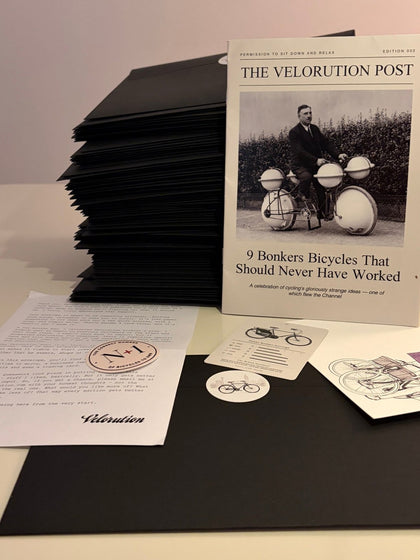
The Velorution Post
Real mail. Once a month.
We're all a bit digitally overwhelmed. So once a month I hand-pack an envelope and post it to you — a 16-page mini magazine, a letter, a collectable card. Things worth keeping, not junk through the door.

The Velorution Post
My pride and joy, through your letterbox
A 16-page mini magazine every month. No ads, just bicycle love. In the envelope with it:
- A letter from me
- A collectable trading card
- My real numbers, warts and all
Brompton P Line 12-speed — the one that does everything
£2,599, 10.77kg — or £2,679 and 10.87kg with the Roller Frame, again the version usually on the shelf. Full gearing range and the lightest full-gearing Brompton you can buy without going to T Line money. It's also the weakest value of the four on paper, at 81p per gram. But if you have hills and stairs, it is the only bike here that answers both, and being the only answer counts for something.
See the P Line 12-speed — £2,679 →
IMAGE CREDIT: Brompton
If you really want to play the weight game
There is a rung above all of this, and it makes the P Line look restrained. The T Line starts at £4,549 for the 1-speed at 7.45kg, with a full titanium main frame and carbon fork, bars and crankset. The 12-speed is £4,969 at 8.8kg.
Run the same sum on it. Going from a C Line 12-speed at £1,599 and 12kg to a T Line 12-speed at £4,969 and 8.8kg costs £3,370 for 3.2kg — about £1.05 per gram. So the T Line is worse value per gram than either P Line, which is what you'd expect at the top of any range: the last grams always cost the most. It's a beautiful object and a genuinely remarkable piece of manufacturing, and it is not a rational purchase. It sits in our round-up of the lightest folding bikes for good reason.
Meanwhile, in the other direction, the G Line goes to 20" wheels, 8-speed hub gearing and hydraulic discs at 14.8kg — a heavier, more capable Brompton for bigger riders and rougher roads. If your instinct on reading all this is that you'd rather have capability than lightness, read Brompton G Line vs C Line instead. And if the whole premise still feels like a lot of money for a small bicycle, that's a fair question and I've tried to answer it properly in are Bromptons worth it?
The verdict
Buy the C Line 12-speed at £1,599. For the overwhelming majority of people, including most of the people currently talking themselves into a P Line, it is the right bike: full gearing range, the same hand-brazed frame, the same 7-year registered warranty, and a thousand pounds still in your account.
Buy the P Line — and make it the SuperRoll+ — only if you carry the folded bike several times every single day. Multi-leg train commutes, stairs without lifts, a top-floor flat. In that life the 1.23–1.44kg is the whole point and the money is well spent. Take the 4-speed if your route is flat, because it's the better deal per gram; take the 12-speed if you have hills, because nothing else covers both problems.
And if you're buying the P Line because 9.86kg is a nicer number than 11.3kg, that's allowed. Just be honest with yourself that it's what you're doing, and enjoy it. Most of us have bought worse things for weaker reasons.
You can see the current range, with live UK prices, in the Velorution Brompton collection.
Some links on this page are affiliate links: if you buy through them, the retailer may pay Velorution a small commission at no cost to you. It never changes what I recommend, and I only link to bikes I'd genuinely point a friend towards. Prices and weights were checked in August 2026 and can change.
Leave a comment
No comments yet — be the first.

Velorution Exclusive · October
Define Bicycle Mug
£18.00. One month only. Then it retires to the Velorution Vault and may never be seen again.
Get it before it's goneFrom the Collective


More stories

