
Buying Guides
Brompton G Line vs C Line: The Bigger Brompton, Explained

For thirty-odd years, a Brompton meant 16-inch wheels. That was the deal. The wheels were small because the fold had to be small, and the fold being small was the whole point of the thing. Then, in late 2024, Brompton put out the G Line — 20-inch wheels, hydraulic disc brakes, three frame sizes — and a lot of people read that as the company finally fixing the Brompton.
It isn't. The G Line is Brompton answering a different question, and if you buy it expecting a better C Line you will be disappointed on the first train platform. Here's what actually changes, what it costs you, and which one belongs under you.
The short version
The C Line is the true city fold: 11.3–12kg, a parcel small enough to carry through a ticket barrier and shove under a café table, from £1,399. The G Line is £2,599, 14.8kg, and folds into something noticeably bigger. In exchange you get bigger wheels, proper hydraulic braking, an eight-speed hub, tubeless-ready rims, and — this is the underrated bit — three frame sizes covering riders from 152cm to 198cm.
If your journey involves carrying the bike, the C Line wins and it isn't close. If your journey involves riding the bike a long way over indifferent surfaces and only folding it occasionally, the G Line starts making sense.

IMAGE CREDIT: Brompton
What 20-inch wheels actually change
More than the number suggests. A bigger wheel rolls over a given pothole edge at a shallower angle, which is a dry way of saying it doesn't try to stop dead when the tarmac gives up. On a 16-inch Brompton you learn to read the road surface — you unweight the bars over the bad bits, you pick lines around drain covers. It becomes second nature and you stop noticing you're doing it. Then you ride something with 20-inch wheels and realise how much attention you'd been spending.
The G Line also feels calmer at speed. Small wheels are quick to steer, which is brilliant in traffic and slightly nervous on a fast descent. The G Line trades some of that darting quality for stability. Wider bars help too. It rides like a bike that happens to fold, where a C Line rides like a fold that happens to be a bike — and I mean that as a compliment to both.
Tubeless-ready rims are a quiet upgrade nobody advertises properly. Thorn punctures on a folder are miserable, because the small wheel means more revolutions and more chances to find the one bit of hedge trimming on the lane. A tubeless setup shrugs most of them off.
The brakes are the biggest single change
The G Line runs hydraulic discs — 140mm rear, 160mm front. Coming from the C Line's calipers this is not a subtle difference. It's one-finger braking, in the wet, fully loaded, downhill, without thinking about it.
Does the C Line need discs? For flat urban riding, honestly, no. Its brakes are fine for what it's asked to do. But add a hill, add rain, add luggage, add a rider at the heavier end of the range, and the case for hydraulics stops being theoretical. That's exactly the use case Brompton built the G Line for.
Eight gears in a hub, and why that matters
The G Line uses an eight-speed internal hub. Not a derailleur, not the C Line 12-speed's clever hybrid of a three-speed hub and a four-speed derailleur.
An internal hub is the low-maintenance option: nothing hanging off the back to bend, you can change gear while stationary at lights, and the chain runs straight. On a bike aimed at rough surfaces and all-weather riding, that's the sensible engineering choice. The C Line 12-speed offers a wider spread — 402% range — but does it with more moving parts in the open.
The four-speed C Line, meanwhile, is the simple one. Four gears sounds thin until you ride it and discover that four well-chosen ratios cover a city perfectly well. I've written more about how those two C Lines differ in the C Line versus P Line comparison, where the gearing question comes up again.
Three sizes — the bit that gets buried
Every other Brompton is one size, adjusted by seatpost and handlebar choice. It works remarkably well across a wide range of people, which is part of why the design has lasted. But "remarkably well" is not "well" if you're 195cm, and taller riders have spent years explaining that a Brompton fits them the way a hire car fits them — technically, with compromises.
The G Line comes in S, M and L, covering 152cm to 198cm. For a rider at either extreme of that range this is a bigger deal than the wheels, the brakes or the hub. It's the difference between a bike that accommodates you and a bike that's actually your size.
Three colours: Forest Green, Adventure Orange and Traildust White. The naming tells you plainly who Brompton think is buying it, and it isn't someone commuting three stops on the Northern line.

IMAGE CREDIT: Brompton
Now the costs
Two of them, and both are real.
Weight. 14.8kg against 11.3kg for the C Line 4-speed and 12kg for the 12-speed. Three and a half kilos does not sound like much written down. Carried up a flight of station stairs at 8am it is a completely different experience. The C Line is a bike you carry without resenting it. The G Line is a bike you'd rather wheel.
Fold size. The G Line folds — it's still a Brompton, the same basic three-stage origami — but bigger wheels make a bigger parcel: 690 × 730 × 402mm against the classic fold's 585 × 565 × 270mm — more than twice the volume, by Brompton's own figures. That has consequences you only discover in use: under the desk, in the boot, in the luggage rack of a busy train, in the hallway of a flat where the bike lives behind the door. The C Line's fold is the tightest of any properly usable folding bike, and it's the reason Bromptons became Bromptons. The G Line gives some of that back.
Urban cycling news, honest stories, and a front-row seat as we rebuild Velorution from scratch. Free, every week.
Join 40,000+ following along
Price. £2,599 against £1,399 for the C Line 4-speed and £1,599 for the 12-speed. You are paying nearly twice as much, and for many riders you'd be paying it to make the bike worse at the one job you actually need it to do.
The comparison, side by side
| C Line 4-speed | C Line 12-speed | G Line 8-speed | |
|---|---|---|---|
| Price from | £1,399 | £1,599 | £2,599 |
| Weight from | 11.3kg | 12kg | 14.8kg |
| Wheels | 16" | 16" | 20", tubeless-ready |
| Folded size (H × L × W) | 585 × 565 × 270mm | 585 × 565 × 270mm | 690 × 730 × 402mm |
| Brakes | Caliper | Caliper | Hydraulic disc, 140/160mm |
| Gears | 4 | 12 (3-speed hub × 4-speed derailleur), 402% range | 8 (internal hub) |
| Frame sizes | One size | One size | S / M / L, 152–198cm |
| Frame | Steel | Steel | Steel |
The Electric G Line, briefly
There is an electric version: the Electric G Line SuperRoll+ at £3,499, running Brompton's e-Motiq system. It weighs 19.5kg including the battery.
e-Motiq is a 250W rear hub motor — moved from the front wheel, where the old Brompton Electric system put it — with 24Nm of torque, rising to 30Nm on the G Line. The battery is 345Wh and removable, charging 0–80% in four hours and to full in five. Brompton quote up to 90km of range across the e-Motiq bikes, but for the Electric G Line specifically they say 30–60km, which is the honest figure given what the bike weighs and where it's meant to go.
19.5kg is a lot of folding bike. If you were on the fence about carrying a 14.8kg G Line, the electric one settles the argument: this is a bike you fold to store and to put in a car, not one you fold to carry. Worth reading alongside the full Brompton electric comparison before committing that kind of money.

IMAGE CREDIT: Brompton
Who should buy the G Line
Three sorts of rider, in my view.
- Tall or short riders outside the range a one-size Brompton flatters. If a standard C Line has never quite fitted you, the S/M/L option changes the whole calculation.
- One-bike-for-everything people. If this is your only bike — commute, weekend, towpath, gravel lane, the odd tour — the G Line does all of it competently and still folds enough to live in a flat. A C Line does the first one better and the rest worse.
- Riders whose commute isn't smooth. Broken tarmac, cobbles, unsurfaced sections, hills in the rain. The wheels and the brakes both earn their keep.
See the G Line 8-speed — £2,599 →
Who should buy the C Line
Nearly everyone else, and I don't say that to be contrary.
The C Line is what happens when a design gets refined for decades against one clearly-stated problem: get a usable bicycle into a package a person can carry onto public transport. Everything about it — the steel frame, the fold, the front carrier block, the folding pedal — serves that. It is still the best answer anyone has to that question.
IMAGE CREDIT: Brompton
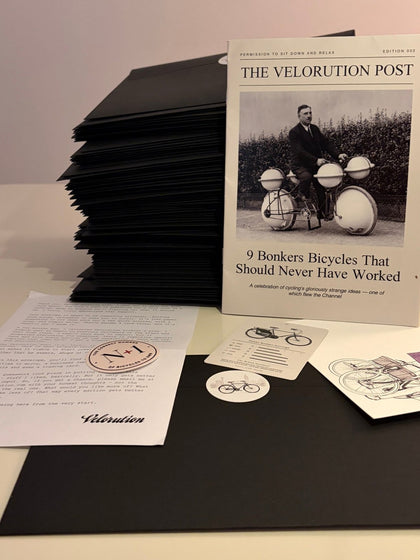
The Velorution Post
Real mail. Once a month.
We're all a bit digitally overwhelmed. So once a month I hand-pack an envelope and post it to you — a 16-page mini magazine, a letter, a collectable card. Things worth keeping, not junk through the door.

The Velorution Post
My pride and joy, through your letterbox
A 16-page mini magazine every month. No ads, just bicycle love. In the envelope with it:
- A letter from me
- A collectable trading card
- My real numbers, warts and all
Between the two C Lines: the 4-speed at £1,399 and 11.3kg is the lighter, simpler, cheaper bike, and four gears is genuinely enough for flat cities. The 12-speed at £1,599 and 12kg buys you a 402% gear range, which is what you want if you live somewhere with hills or you carry shopping. Both get mudguards, the front carrier block and the full colour range, which is what separates the C Line from the entry-level A Line.
See the C Line 12-speed — £1,599 →
See the C Line 4-speed — £1,399 →
A note on buying either one
Both are built in Greenford, West London, and both carry the same warranty terms: seven years on the frame if you register it through My Brompton, two years otherwise, and two years on components. Brompton had a hard 2025 — 78,530 bikes sold, down 7.5% on the previous year, £121.45m turnover and a £2.1m net loss — so it's worth knowing the warranty is properly underwritten rather than a marketing number. Both sit in our Brompton collection if you want to compare the full current range.
Resale holds up too. Used C Lines commonly sit around £650–£920 on eBay UK, which for a bike bought at £1,399 is unusually kind depreciation. The G Line is too new to have a settled second-hand market, so treat that as an unknown rather than a promise. If the total cost of ownership is what's on your mind, the are Bromptons worth it piece works through the sums properly.
One practical suggestion: try to ride both, and try to fold both. Everybody test-rides. Almost nobody test-folds, and the fold is the thing you'll do twice a day for a decade. Fold a G Line, pick it up, walk twenty paces with it. Then do the same with a C Line. That comparison will decide this for you faster than any spec sheet — mine included.
The verdict
Buy the C Line. For the overwhelming majority of people asking this question — city riders, commuters, anyone who carries the bike as part of the trip — the C Line 12-speed at £1,599 is the right Brompton, and the 4-speed at £1,399 is the right one if your city is flat and you value the lighter 11.3kg.
Buy the G Line if you fall into one of three camps: you're at the tall or short end where S/M/L genuinely matters, you want one bike that handles rough surfaces as well as streets, or you fold your bike to store it rather than to carry it. In those cases £2,599 buys real capability, not a badge.
What the G Line isn't is the new best Brompton. It's a second, wider answer sitting next to the original one — and the original one is still the finest folding bike made.
Some links on this page are affiliate links: if you buy through them, the retailer may pay Velorution a small commission at no cost to you. Prices and weights verified 26 August 2026 and correct at time of writing.
Leave a comment
No comments yet — be the first.

Velorution Exclusive · October
Define Bicycle Mug
£18.00. One month only. Then it retires to the Velorution Vault and may never be seen again.
Get it before it's goneFrom the Collective


More stories

