
Buying Guides
Electric Brompton C Line vs P Line (and the Cambridge Bike That Costs the Same)

Brompton has quietly redone its electric bikes, and the change is bigger than the spec sheet suggests. The motor has moved from the front wheel to the rear hub. There is a new system name — e-Motiq — a new battery, and an app that spends your first 100km working out how you ride before it decides how much to help you. It is the most convincing electric Brompton yet.
It is also, depending on which one you pick, between £2,999 and £5,999. And somewhere in the middle of that range sits a folding electric bike made in Cambridge that weighs less than any of them, costs exactly what the cheapest Brompton costs, and almost nobody has heard of.
So this is two comparisons in one. First, the Electric C Line against the Electric P Line — the two Bromptons most people are actually choosing between. Then the awkward question of the Flit M2i, which I don't think Brompton has a clean answer to.
What e-Motiq actually is
Every electric Brompton now runs the same system, whether it's the £2,999 one or the £5,999 one. That's worth saying plainly, because it means the money you spend above the entry price buys you frame and weight, not more motor.
The numbers:
- 250W rear hub motor, 24Nm of torque (up to 30Nm on the G Line). The old system drove the front wheel. This one drives the back.
- 345Wh removable battery, with a claimed range of up to 90km.
- 0–80% charge in four hours, 0–100% in five.
- Handlebar control plus the Brompton Electric App, which learns your riding pattern over the first 100km. There's walk-assist at 6km/h and start-assist for pulling away.
The move to the rear hub is the headline. Front-hub assist on a small-wheeled folder always felt slightly like being towed — fine in a straight line, odd when you leaned into a wet corner and asked the front wheel to both steer and pull. Rear drive puts the shove where your weight is. It also means the front end folds and lifts like a normal Brompton rather than one with a lump in the wheel.
The 90km claim is a claim, as all range claims are. It assumes low assist, a light rider and sensible terrain. Treat it as the ceiling and plan around something well below it, especially in a hilly city. Brompton itself quotes 30–60km for the Electric G Line, which is the same battery in a heavier bike — that gap tells you more about real-world range than the headline figure does.

IMAGE CREDIT: Brompton
Electric C Line — from £2,999, 17.3kg
This is the one most people should look at first, and the one most people will buy.
It's the classic hand-brazed steel Brompton — mudguards, front carrier block, folding left pedal, the full colour range — with the e-Motiq system bolted into it. Four-speed gearing. £2,999 to start, or £3,079 for the SuperRoll+ version, which is the one I'd take: the extra rollers make wheeling the folded bike along a platform genuinely tolerable rather than a chore.
The weight is the thing you have to make peace with. 17.3kg from, and 17.9kg for the SuperRoll+. A non-electric C Line 12-speed is 12kg. So you are adding a little over five kilos — which is nothing while you're riding, and a great deal while you're carrying the folded bike up a flight of stairs at a station with a broken lift.
That's the honest trade. The battery comes off, which takes some of the sting out of the lift, but you're still hoisting a 17kg object. If your commute is bike–train–bike with steps at both ends, think hard. If it's mostly riding with a fold at each end, the weight is a non-issue and this is a lot of bike for the money.
Shop the Electric C Line SuperRoll+ at Brompton — £3,079 →
If £3,000 in one go is the sticking point rather than the bike itself, Brompton will rent you one. The Brompton subscription starts at £75/month for the Electric C Line, includes servicing and insurance, and lets you find out whether you actually want an electric folder before you own one. I've written up the full maths on that elsewhere, including the bits of small print worth reading.
Electric P Line — £3,879, 16kg (and currently out of stock)
The P Line is Brompton's lightweight tier: titanium rear frame and fork in place of steel, which on the non-electric bikes saves you a couple of kilos. Electrified, it comes in at 16kg against the Electric C Line's 17.3kg.
So: £880 more for 1.3kg less.
Write it down like that and it looks absurd, and I'm not going to pretend otherwise. £677 per kilo is silly money by any rational measure. But nobody buying a titanium-framed folding bike is being entirely rational, and 1.3kg is not nothing when you're the one lifting it. Somewhere around 16kg a folded electric bike stops being a thing you dread and becomes a thing you tolerate. Whether that line falls between 16 and 17.3 for you is genuinely personal.
The P Line also just rides better. Same reasons as the standard bikes — the titanium rear end takes some of the buzz out of a small wheel on bad tarmac. If you want the full breakdown of what the frame change does, I've compared the two properly in C Line vs P Line.
One practical note: the Electric P Line moves in and out of stock, so check availability before you set your heart on a colour.

IMAGE CREDIT: Brompton
Check Electric P Line availability at Brompton →
The other two, briefly
Electric G Line SuperRoll+ — £3,499, 19.5kg
Twenty-inch wheels, hydraulic discs, up to 30Nm of torque, and 19.5kg on the scales. This is not a lighter, more portable Brompton — it's a bigger one. The fold is chunkier and the bike is heavier than everything else here by some margin.
It exists for people the standard Brompton doesn't fit, or roads the standard Brompton doesn't like: gravel paths, potholed A-roads, taller riders. Brompton quotes 30–60km range on this one rather than 90km, which is the same battery having to work harder. Buy it if you want an all-road electric bike that happens to fold, not if you want a folding bike that happens to be electric.
Urban cycling news, honest stories, and a front-row seat as we rebuild Velorution from scratch. Free, every week.
Join 40,000+ following along

IMAGE CREDIT: Brompton
Shop the Electric G Line at Brompton →
Electric T Line — £5,799 to £5,999, 13.8kg
Titanium main frame, carbon fork and bars, and the lightest electric Brompton by a distance: 13.8kg for the 1-speed at £5,799, 14.6kg for the 4-speed at £5,999. It is a remarkable object and I'd happily own one.
It is also six thousand pounds. Hold that number for the next section, because it's about to look strange.

IMAGE CREDIT: Brompton
Shop the Electric T Line 4-speed at Brompton →
And then there's the Flit M2i
The Flit M2i costs £2,999. That is not approximately the Electric C Line's starting price. It is exactly the Electric C Line's starting price.
It weighs 13.3kg.
Read those two lines together. For the price of the heaviest, cheapest electric Brompton, you get a folding electric bike four kilos lighter — and lighter, by half a kilo, than the £5,799 Electric T Line. A bike costing £2,800 less than Brompton's titanium-and-carbon flagship undercuts it on the one number that flagship exists to win.
The rest of the M2i is not a compromise either. Bonded aluminium frame — structural adhesive rather than welding, which is how you get stiffness without weight penalties at the joints. Hope hydraulic brakes, made in Barnoldswick, which is proper kit rather than an own-brand caliper. Goodyear tyres. Five assist levels, integrated lights, roughly three hours to charge. Built in Cambridge and sold direct from Flit's own site.
I've spent proper time with this bike and written the full story of it separately — the Flit M2i and the small Cambridge company behind it is worth reading before you spend three grand on anything that folds. It also sits near the top of my lightest folding e-bikes roundup, which is where the weight comparison across the whole category lives.
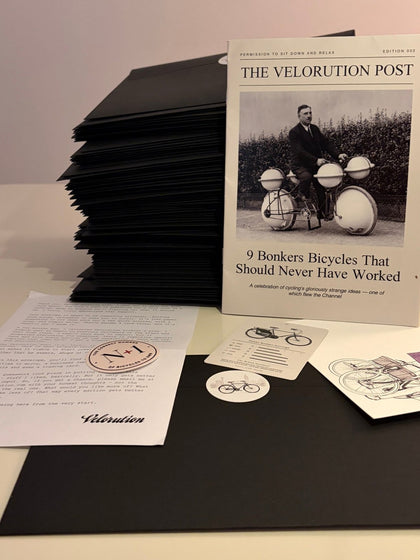
The Velorution Post
Real mail. Once a month.
We're all a bit digitally overwhelmed. So once a month I hand-pack an envelope and post it to you — a 16-page mini magazine, a letter, a collectable card. Things worth keeping, not junk through the door.

The Velorution Post
My pride and joy, through your letterbox
A 16-page mini magazine every month. No ads, just bicycle love. In the envelope with it:
- A letter from me
- A collectable trading card
- My real numbers, warts and all
The comparison
| Electric C Line | Electric P Line | Electric T Line 1-sp | Flit M2i | |
|---|---|---|---|---|
| Price | from £2,999 | from £3,879 | £5,799 | £2,999 |
| Weight (incl. battery) | 17.3kg | 16kg | 13.8kg | 13.3kg |
| Claimed range | up to 90km | up to 90km | up to 90km | 50km |
| Battery | 345Wh removable | 345Wh removable | 345Wh removable | — |
| Motor | 250W rear hub, 24Nm | 250W rear hub, 24Nm | 250W rear hub, 24Nm | 5 assist levels |
| Charge time | 4h to 80%, 5h full | 4h to 80%, 5h full | 4h to 80%, 5h full | ~3h |
| Gears | 4 | 4 | 1 | — |
| Frame | Steel | Titanium/alu/steel/carbon | Titanium + carbon | Bonded aluminium |
| Brakes | — | — | — | Hope hydraulic |
| Made in | Greenford, London | Greenford, London | Greenford, London | Cambridge |
| Frame warranty | 7 years (registered) | 7 years (registered) | 7 years (registered) | — |
| Where to buy | Dealers + direct | Dealers + direct | Dealers + direct | Direct only |
The honest trade-offs
I like the Flit a great deal, and I'm not about to tell you it beats a Brompton on everything, because it doesn't.
What Brompton still wins:
- The fold. Decades of iteration on one design. Nothing else gets that small, that reliably, that fast. It's the entire reason the company exists and it remains the best in the world at it.
- Range. 90km claimed against Flit's 50km. Even discounting both figures, the Brompton has more headroom. If your riding is long or you're bad at remembering to charge things, that gap matters.
- The dealer network. You can walk into a shop in most decent-sized towns and have a Brompton looked at. Flit is direct-only.
- Seven years on the frame if you register it via My Brompton, plus two on components.
- Luggage and parts. Decades of front-block bags, racks and spares. That's a real practical advantage nobody talks about until they need a specific bracket on a Tuesday.
- Resale. Bromptons hold value in a way almost no other bike does.
What Flit wins:
- Weight. 13.3kg against 17.3kg for the same money. Four kilos is the difference between carrying a folded bike and dragging one.
- Value. Hope hydraulic brakes and Goodyear tyres, on a 13.3kg bike, at the same £2,999 the entry electric Brompton asks.
- Charge time. Roughly three hours versus five.
The gap that actually decides it is range against weight. Brompton has built an electric bike you can ride a long way and would rather not carry. Flit has built one you can carry easily but shouldn't plan a 70km day on. Neither is wrong. They're answers to different questions, and the question you need to answer is which half of your commute you dread.
The verdict
Buy the Electric C Line SuperRoll+ at £3,079 if your riding is mostly riding — long-ish trips, the odd fold at each end, no stairs to speak of. It's the most capable of these bikes on the road, the ecosystem around it is unmatched, and the rear-hub e-Motiq system has fixed the one thing that was genuinely wrong with electric Bromptons.
Buy the Flit M2i at £2,999 if you carry the thing. Trains, stairs, offices, lifts that don't work. Four kilos lighter for identical money is not a close call, and 50km covers the overwhelming majority of actual commutes. Read my full piece on it first, because buying direct from a small Cambridge company is a different kind of decision to buying a Brompton.
The Electric P Line at £3,879 is for people who want a Brompton and want it lighter and have made peace with paying £880 for 1.3kg. That's a legitimate position. Just don't let anyone tell you it's good value.
The Electric T Line is hard to defend against the Flit on numbers alone — it's £2,800 more for half a kilo more weight. What it's actually selling is the fold, the finish and the fact that it's a Brompton, and if that's what you want then no comparison table is going to change your mind. Fair enough.
And if you're not sure you want an electric folder at all: £75/month gets you an Electric C Line on subscription with servicing and insurance included. Ride one for six months before spending three grand. I've picked apart whether the subscription is worth it, and there's more on the broader question in are Bromptons worth it.
The full electric and non-electric range sits in the Velorution Brompton collection, with live UK prices.
Some links on this page are affiliate links: if you buy through them, the retailer may pay Velorution a small commission at no cost to you. It never changes what I recommend or what I say about it.
Leave a comment
No comments yet — be the first.

Velorution Exclusive · October
Define Bicycle Mug
£18.00. One month only. Then it retires to the Velorution Vault and may never be seen again.
Get it before it's goneFrom the Collective


More stories

