
Latest Stories
The Man Who Invented the Strida

"Hey Mark, how are you?”
“I’m good, thanks. Just got back home - I’ve been out all afternoon.”
“What have you been doing?”
“Oh… just building an aircraft.”
That kind of answer tells you everything about Mark Sanders.
After I published a short piece about the Strida in our last issue - prompted by the number of you who wrote in about the bikes you'd bought from Velorution - something unexpected happened. Mark got in touch.
I couldn't resist the opportunity, so I asked if we could speak about the origin of the Strida and, to my delight, he agreed.
From engineer to designer
Mark grew up cycling. Not racing - just riding. Getting from A to B. It was, as he says, his source of freedom.
He trained first as an engineer.
But it was a master’s degree in Engineering and Design at the Royal College of Art that changed his perspective from building "clever machinery" to designing things that actually worked for people.
The 22-mile commute
While he studied, Mark had a 22-mile commute. Too far to cycle comfortably. Too awkward to solve with public transport alone - always that last-mile problem.
Then he realised something. That unsolvable journey wasn't just his problem. It was the perfect opportunity for his studies. And he knew what he needed to create.
This was 1982. Folding bikes existed, but barely. The ones that did were heavy, sharp-edged, and difficult to use - whether that be riding, folding or carrying.

Mark's original Masters thesis. Credit: Mark Sanders
Back to basics
With his problem/opportunity identified, Mark went back to first principles.
Triangles are the strongest shape. An upright riding position is the most comfortable. Everything else followed from there.
The frame design drew inspiration from the McLaren baby buggy - at the time, a revolutionary folding pushchair that had recently transformed how parents travelled. If a buggy could fold that elegantly, why couldn't a bike?
He built models. Then a full test rig - fully adjustable, designed to find the optimal ergonomics before a single production component was made. The rig set the key parameters. Then he checked everything against British production standards and built the first prototype.
Three tubes. Three joints. A Kevlar belt instead of a chain. A triangular silhouette unlike anything else on the road.
What Mark noticed almost immediately was the attention it attracted. The Sunday Times covered it. Lotus came knocking. Even as a prototype, it had something - a quality that made people stop and stare.

Mark's original Masters thesis. Credit: Mark Sanders
Getting it made
After completing his studies, Mark looked for a business partner to help bring the bike to market. Eventually he found the perfect partner in James Marshall - a sports entrepreneur who didn’t try to adjust or put constraints on his design. This kept Mark’s unique design pure, rather than it being watered down.
The frame was aluminium. Many components were plastic - a deliberate choice rooted in something Mark felt strongly about. If a product is going to be genuinely useful to society, it has to be affordable.
The first Strida sold in 1986 for £199. Comparable folding bikes at the time were fetching £400 to £500.
The Strida was built in Nottingham and launched to significant attention - but sales were disappointing in the UK.
Urban cycling news, honest stories, and a front-row seat as we rebuild Velorution from scratch. Free, every week.
Join 40,000+ following along

Mark's original business plan. Credit: Mark Sanders
Britain, it turned out, wasn't ready for a triangular bicycle. The Sunday Times had covered it. Lotus had come knocking. But on the streets of London and Nottingham, the reaction from ordinary commuters was more complicated. Riding a triangle through a British city meant standing out. Looking different. Inviting stares.
And as Mark puts it, with the kind of bluntness that comes from forty years of experience: "Brits don't like weird stuff."
It is a particularly British paradox. A nation that produced some of the most innovative product design of the twentieth century - and yet one where the cultural instinct is quietly, firmly, not to stand out.
The Strida, with its unmistakable silhouette and belt-driven silence, was many things. Invisible was not one of them.

Where it did take off
Japan was a different story entirely.
In Tokyo, in Osaka, in cities across the Far East, the Strida found something it had struggled to find at home: an audience that celebrated rather than tolerated innovation. Cultures where a distinctive, beautifully engineered object on the street was something to be admired and celebrated.
The Strida didn't just sell in Japan. It thrived. It became part of the urban fabric - spotted folded in cafés, leaning against office walls, rolling through subway stations. Exactly the multi-modal, last-mile solution Mark had imagined in that RCA studio in 1982.

The hard years
Back in Britain in the 1990s, the original company was struggling. Production moved to Portugal to cut costs as the company tried to expand too quickly with the addition of a baby buggy.
It’s a well-trodden path (especially in the cycling industry) and, like many others before and since, the business went under.
The IP, though, returned to Mark.
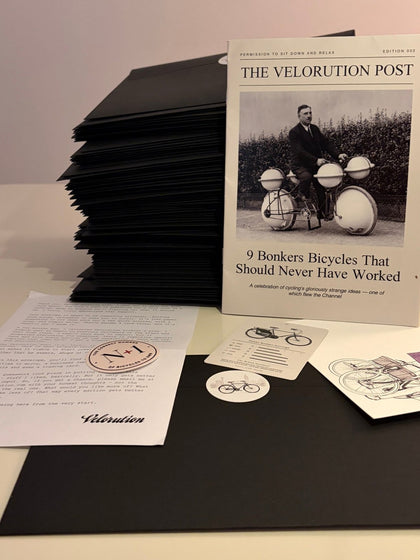
The Velorution Post
Real mail. Once a month.
We're all a bit digitally overwhelmed. So once a month I hand-pack an envelope and post it to you — a 16-page mini magazine, a letter, a collectable card. Things worth keeping, not junk through the door.

The Velorution Post
My pride and joy, through your letterbox
A 16-page mini magazine every month. No ads, just bicycle love. In the envelope with it:
- A letter from me
- A collectable trading card
- My real numbers, warts and all
Strida wasn’t dead. But Mark had it on life support.
Eventually a company called Roland Plastics helped restart it. Demand picked up, but an expansion into the US meant they couldn’t keep up.
The US importer took the business over and discovered a similar fate.
In 2007, Ming Cycle - one of the largest bicycle manufacturers in the world you may never have heard of - acquired it. They still make it today.
The Folding Bike Revolution
Strida didn’t become the ubiquitous folding bike. Brompton did.
And Brompton did an amazing job at making folding bikes familiar and mainstream.
Strida, though, endures.
It remains distinctive. Unapologetically different. A design that solved the problem on its own terms.
And it has attracted a following unlike almost any other bike. Strida clubs have sprung up across Korea, Taiwan, Japan and even Russia, attracting equal numbers of male and female riders - quite a rare achievement in cycling - and something that has led to Mark being invited to several weddings!
The Strida, as Mark says, is a Marmite product. But I bloody love Marmite.
Leave a comment
No comments yet — be the first.

Velorution Exclusive · October
Define Bicycle Mug
£18.00. One month only. Then it retires to the Velorution Vault and may never be seen again.
Get it before it's goneFrom the Collective


More stories

