
Latest Stories
How Fast Are Folding Bikes? The Data on Small Wheels and Speed

Ask how fast a folding bike is and you'll get one of two answers: a shrug, or a lecture about wheel size from someone who has never ridden one. Neither is much use. So here are the actual numbers — how folding bikes compare with road bikes, city bikes and everything else, what genuinely determines speed on a bicycle, and which folding bikes are quick. With data, because this question deserves better than vibes.
How fast are folding bikes? At a glance
- Typical folding bike commuting average: 10–14 mph (16–22 km/h) — within a whisker of a hybrid, and 1–3 mph slower than a road bike door to door.
- Top speed isn't the limit — gearing is. A single-speed Strida runs out of gear at around 12 mph; a 54-tooth Brompton will happily sit at 20 mph.
- Small wheels are not slow. The flying 200m record for a conventional riding position — 51.29 mph — was set on 17-inch wheels, and has stood since 1986.
- In stop-start city traffic, folding bikes close the gap: small wheels accelerate faster, and above about 9 mph air resistance matters more than anything on the bike anyway.
- Folding e-bikes are the fastest folders in practice — a 15.5 mph assist cap, held nearly all the time, beats a faster bike ridden slower.
Average speed by bike type: the data
The most complete public dataset on this comes from Discerning Cyclist's long-running analysis of average cycling speeds, which puts regular riders on road bikes at 13–17 mph, hybrids at 11.5–13 mph, city bikes at 8–12 mph and mountain bikes at around 10 mph on tarmac — with the average person pedalling along at about 12.6 mph. Copenhagen, the most-measured cycling city on earth, clocked its riders at between 9.6 and 12.8 mph across the city.
Folding bikes are the gap in almost every one of these datasets, so here's my estimate from the gearing and the riders I actually see: 10–14 mph, with single-speed small-wheelers at the bottom of that range and well-geared 16–20" folders at the top, overlapping the hybrids.
Typical commuting averages by bike type (mph)
Bar length shows the midpoint of each range. Data: Discerning Cyclist; folding bike range is our estimate.
Two things jump out of that chart. First, the folding bike bar sits closer to the road bike than to the Dutch bike — the gap between a Brompton and a hybrid over a five-mile commute is a minute or two, not a different league. Second, the e-bike bar is an average being dragged down by cautious riders: a confident rider on a folding e-bike holds the legal 15.5 mph assist limit almost continuously, which makes it the fastest thing on this chart in real traffic. More on that below.
Folding bikes vs everything else: the comparison table
| Bike type | Average (mph) | Weight (kg) | Where it wins |
|---|---|---|---|
| Folding (16") | 10–14 | 7.5–12 | Door-to-door time, trains, storage |
| Folding (20"+) | 11–15 | 11–14 | Longer commutes, rougher roads |
| Road bike | 13–17 | 7–10 | Open roads, distance |
| Gravel bike | 10–15 | 9–11 | Mixed surfaces |
| Hybrid | 11.5–13 | 11–14 | All-round commuting |
| City/Dutch bike | 8–12 | 15–22 | Comfort, short hops |
| Mountain bike | ~10 on tarmac | 13–16 | Not tarmac |
| E-bike (capped) | 11–14.3 | 18–25 | Hills, arriving unsweaty |
Worth noting what the table folds in: the folding and city bikes put you upright, road and gravel bikes put you low and tucked — and as we'll see in a moment, that position difference explains most of the speed gap, not the wheels.
The table also hides the most important number, because speed on paper isn't the same as time to destination. A folding bike goes with you onto the train, into the office and up to the flat — no locking up, no walking from the bike parking, no discovering someone's had your saddle. On a multimodal commute the folder routinely beats every bike on this table door to door while being the "slowest" bike in the group. That's the trick the spreadsheet misses — and we'll put minutes on it at the end.
What actually makes a bike fast
1. Air resistance — the big one
From about 9 mph, pushing air out of the way costs more than everything else combined, and the cost rises with the cube of your speed. At 20 mph, air resistance is roughly four times the rolling resistance. And here's the thing: around 70–80% of that drag is you, not the bike. Your body position matters more than anything you can buy.
Where your effort goes, on the flat
Approximate share of total resistance. Black: air. Red: rolling and drivetrain.
This is quietly good news for folding bikes. The upright position costs you top-end speed against a tucked road rider, sure. But it's the same position as a hybrid or Dutch bike, and at city speeds — 10 to 15 mph — the aero penalty is modest. The folding bike isn't losing much where it actually gets ridden.
2. Weight — matters less than you think, except when it doesn't
On the flat, at constant speed, weight barely registers — physics doesn't charge you for mass you're not accelerating or lifting. Weight costs you in exactly three places: hills, acceleration, and your own arms when you carry the thing. City riding is acceleration over and over again — every junction, every light — which is why a light bike feels so much faster in town than the flat-road numbers say it should. And the carrying bit is the whole point of a folder: a 20 kg folding e-bike is a fast bike and useless luggage at the same time.
3. Wheel size — the myth that won't die
Small wheels have a reputation for being slow. The physics is more interesting:
- Acceleration: small wheels win. Less rotational inertia means a 16" wheel spins up quicker than a 700c one — an advantage precisely where city riding happens, at the lights.
- Holding speed: big wheels win, slightly. More mass in the rim conserves more momentum, and in theory a larger wheel of the same tyre and pressure has lower rolling resistance.
- Rough surfaces: big wheels win. A small wheel falls further into every pothole and loses more energy over bumps — which is why Moulton put suspension on small wheels from day one, and why Brompton's G Line went to 20".
- Aerodynamics: small wheels actually win. Less frontal area, fewer spokes in the wind.
How much does all this net out to? Here's the killer fact. In 1986, Jim Glover rode a faired Moulton AM — 17-inch wheels — through a flying 200 metres at 51.29 mph, a record for a conventional riding position that still stands, forty years later. Nobody on 700c wheels has beaten it. Small wheels are not the problem. Sitting upright in your coat is the problem, and that's a choice we've all happily made.
4. Gearing — the real folding bike speed limit
This is the one that actually separates the fast folders from the slow ones. A 16" wheel covers far less ground per revolution than a 700c wheel, so a folding bike needs a much bigger chainring to achieve the same effect — it's why a Brompton runs a dinner-plate 50 or 54-tooth ring. Get the gearing right and a small-wheeler cruises with any hybrid. Get it wrong, or fix it at one ratio, and you hit a wall: the single-speed Strida, with its 52 gear inches, spins out at about 12 mph no matter how strong your legs are. The bike isn't slow. The gear is.
So which folding bikes are actually fast?
Weight, gearing and assist, bike by bike. First, the weight picture:
Folding bike weights (kg, manufacturer claimed)
Red bars: electric, battery included.

Image credit: Brompton
Brompton C Line — the honest baseline
Steel frame, 11.3 kg, four gears — and the 54-tooth crankset as standard, which means the entry-level-ish Brompton ships with the fastest gearing in the range. £1,399. On the flat there is very little between this and bikes costing three times as much; you'll feel the weight on the stairs before you feel it on the road.

Image credit: Brompton
Brompton P Line — the quick one
Titanium fork and rear frame bring it to 9.86 kg, and it's offered with the 54T ring. £2,399. Four gears, 1.5 kg less to accelerate at every junction, and the same fold. If your commute has hills or your route has thirty sets of lights, this is where the money shows up.

Image credit: Brompton
Urban cycling news, honest stories, and a front-row seat as we rebuild Velorution from scratch. Free, every week.
Join 40,000+ following along
Brompton T Line — the lightest Brompton, with a catch
Full titanium, 7.45 kg, £4,549 — an astonishing object, one of the lightest folding bikes ever made, and the fastest Brompton to the first corner. The catch: the T Line Urban is single-speed with a 50T ring, so on a long flat you'll eventually just… run out of gear. Glorious to carry, slightly the wrong tool for outright speed.
So what's the fastest Brompton?

Image credit: Brompton
Not the most expensive one. On flat city tarmac, gearing beats grams: the C Line's standard 54T out-gears the T Line's single 50T, and the P Line with the 54T option is the best of both — light enough to fly off the lights, geared tall enough to keep pulling past 20 mph. That's my pick, and I've made the fuller version of this argument (with the whole range compared) in our C Line vs P Line guide and our honest look at whether Bromptons are worth it. If you want to see the question settled at race pace — in a compulsory suit and tie, no less — the Brompton World Championship is at Lee Valley VeloPark on 5 September, and watching is free.

Image credit: FLIT
FLIT M2i — the fastest folder in real traffic
Here's the counterintuitive one. The M2i's motor cuts out at 15.5 mph like every legal UK e-bike — yet in actual city traffic it's quicker door to door than anything else on this page, because it holds that 15.5 mph almost permanently: away from every light, up every rise, into every headwind, with you arriving unsweaty. At 13.3 kg with the battery in the frame, it's the lightest properly-equipped folding e-bike a British maker sells — 500 g under Brompton's Electric T Line at nearly half the price (£2,999 vs £5,799). Built in Cambridge; we told the full story of the M2i when it launched.

Image credit: Prodrive
Hummingbird — the lightest folding bike in the world
A one-piece carbon frame built by Prodrive — the motorsport engineering firm — in Oxfordshire, at a scarcely believable 6.9 kg. £3,495 in single-speed form. It's the proof of how far the weight game can go, though with one gear it meets the same ceiling as every single-speed: brilliant to 15 mph, breathless after. A remarkable machine rather than the fast all-rounder.

Image credit: Strida
Strida — the icon that isn't trying
Mark Sanders' triangular masterpiece: belt drive, no grease, a fold that takes five seconds, around 10 kg. And a single speed of 52 gear inches, which caps it at roughly 12 mph. That's not a flaw — the Strida was designed as a walking accelerator for the last couple of miles, and at that job it's perfect. We've told the Strida's full story before, and interviewed the man who invented it.
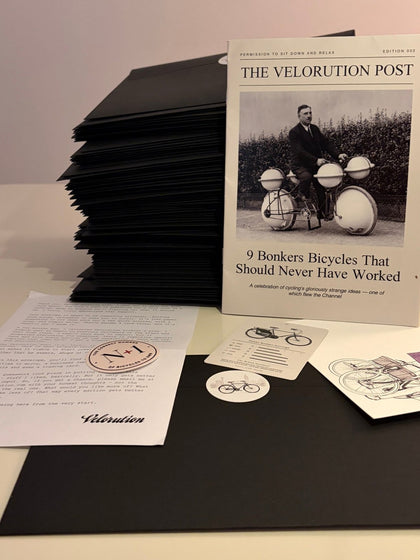
The Velorution Post
Real mail. Once a month.
We're all a bit digitally overwhelmed. So once a month I hand-pack an envelope and post it to you — a 16-page mini magazine, a letter, a collectable card. Things worth keeping, not junk through the door.

The Velorution Post
My pride and joy, through your letterbox
A 16-page mini magazine every month. No ads, just bicycle love. In the envelope with it:
- A letter from me
- A collectable trading card
- My real numbers, warts and all

Image credit: Moulton Bicycle Company
Moulton — the record holder
Not strictly a folder (it separates rather than folds), but no article about small-wheel speed can leave it out: Alex Moulton's spaceframe with full suspension solved the small-wheel bump problem in 1962, and a Moulton has held the conventional-position flying 200m record — 51.29 mph — since 1986. The definitive answer to "aren't small wheels slow?", hand-brazed in Bradford on Avon.

Image credit: Tern
Tern Node D8 — the big-wheel shortcut
Tern's approach to folding speed is simply to use bigger wheels. The Node D8 rolls on 24" wheels with an 8-speed drivetrain for £1,100 — noticeably more road feel than a 16" folder, at the cost of a bulkier fold. If your commute is longer and your train less crowded, it's the sensible trade.
What speed actually means: commuter times
Time to put all of this back into the only units that matter. Take a typical 4-mile urban commute and apply the average speeds from the chart at the top — same rider, same effort, different bike. Riding time alone: a road bike does it in about 16 minutes, a hybrid or a folding bike in about 20, a Dutch bike in 24, and walking takes an hour and twenty. So far, so predictable — the road bike "wins" by four minutes.
Except your commute doesn't end when the wheels stop. The road bike still has to find somewhere to park, get locked (properly, both wheels, this is Britain), and be walked away from — call it five minutes at the destination end, more if the racks are full. The folding bike does none of that. You fold it in twenty seconds at the front door and carry it to your desk. Do the honest arithmetic and the picture changes:
A 4-mile commute, door to door (minutes)
Black: riding time at the average speeds above. Red: parking, locking and walking the last stretch (~5 min) — or, for a folder, folding it and carrying it in (~1 min).
The four-minute riding advantage the road bike earned over four miles is gone at the bike racks, and the folder that "lost" the speed chart arrives level with it — while the folding e-bike quietly beats everything. Add a train into the journey and it isn't close: the folder rolls straight on board while everyone else is queueing for the bike carriage spaces, if there are any. Speed is what the bike does; time is what you get. They're not the same number.
The verdict
Folding bikes sit 1–3 mph behind road bikes on paper and dead level with hybrids — and as the commuter arithmetic above shows, the fold hands those minutes straight back at the bike racks. The physics that supposedly damns them (small wheels) mostly doesn't at city speeds, the thing that actually limits them (gearing) is solved on any well-specced folder, and the fastest of the lot in real traffic is a 13.3 kg e-folder that never drops below the legal limit.
Fast enough, in other words. And yours folds.
Sources
- Discerning Cyclist — Average Cycling Speed by Bike Type (updated May 2025)
- Discerning Cyclist — Are Bigger Bicycle Wheels Faster?
- Moulton Bicycles — Records & Racing (Jim Glover, flying 200m, 1986)
- City of Copenhagen cycling speed measurements (2012)
- Tom Anhalt / tomsarazac.com — wheel size, rolling resistance and aerodynamic analysis
- Brompton, FLIT, Prodrive (Hummingbird), Strida and Tern manufacturer specifications
Some links in this article are affiliate links. If you buy through one, Velorution earns a commission at no extra cost to you — it's how the newsletter stays free. Prices and claimed weights correct at the time of writing.
Leave a comment (2)

Velorution Exclusive · October
Define Bicycle Mug
£18.00. One month only. Then it retires to the Velorution Vault and may never be seen again.
Get it before it's goneFrom the Collective


More stories


Graham Houghton · 4 September 2026
We live in Adelaide, South Australia and ride Lekker ebikes which are great for road trips.They are an upright ride which in traffic gives us the best view of road and the vehicles around us – bit of a generalisation, but Aussie drivers are A not very cyclist aware and B some still regard us as prey. Our requirements when we were looking for our rides were in no particular order – step through frame for ease of mounting (we’re in our 70s), mid-mounted motor for smooth take-up, mudguards, and belt drive with hub gears for minimal maintenance. Recently I’ve been looking at folding bikes as a lightweight alternative for short local journeys. There’s a reasonable choice here, but probably not as good as in Europe. Thing is, I can find all those requirements on folders here except for belt drive and hub gears. Why? I know belts and hub gears add a little to both weight and price, but when you look at a bike as an investment, both those issues disappear. If you’re a manufacturer reading this, please drop your obsession with vulnerable derailleurs and messy chains and give more consideration to user convenience. Great mag looking forward to the first hard copy arriving in our mailbox. Regards Graham Houghton.
Leonora · 28 August 2026
my brompton was the best investment when i moved out of london (even with paying for a gold service every year) – i can keep it with me and save on tube fares, and it is faster than getting to/from the train station on either end than my road bike